
Yu Chunbo
The Chinese version was first published on iprdaily.cn, Date: November 27, 2023
Machine Translated by Google
“What? My post on Douyin has become evidence in civil cases? Yes, in the internet age, there have been cases where defenses have been established based on evidence such as Douyin videos and Tencent videos. With the booming development of emerging public platforms such as self-media, new media, blogs, and document libraries, it is foreseeable that similar use of online evidence may become more and more common.”

Article 22 of the Patent Law stipulates that inventions and utility models granted patent rights must possess novelty, inventiveness, and industrial applicability. Novelty means that the invention or utility model does not belong to the prior art. The Patent Examination Guidelines stipulate that prior art disclosure methods include publication, use, and other methods, none of which are geographically restricted. Disclosure of a technical solution due to use, or making the technical solution publicly known, is called use disclosure.
Based on the above legal provisions, once it is proven that an invention or utility model was already publicly known before the filing date, it constitutes use disclosure, and the solution lacks novelty, thus making it impossible to claim patent rights. Online evidence has gradually become a major form of evidence proving use disclosure. For example, if a patent solution was posted on TikTok to the general public before the filing date, it proves that the patent solution was already publicly known before the filing date. The patent right may be invalidated, and the defendant in an infringement lawsuit may not bear infringement liability.
1. Methods for fixing network evidence
Network evidence usually belongs to audiovisual materials or electronic data in civil evidence, and generally refers to evidence stored and disseminated through the network. In the new civil litigation evidence regulations that came into effect on May 1, 2020, most network evidence belongs to electronic data in terms of evidence type. Due to its technical characteristics, network evidence is easy to be tampered with or deleted, and it is also easy to encrypt and restrict the scope of disclosure, making it difficult to obtain evidence. When used as evidence, network evidence usually needs to be notarized or solidified using tools such as credible timestamps.
For a considerable period of time in the past, various forms of defects have easily appeared in the solidification of network evidence, which has led to doubts about the probative value of the evidence. Around 2012, a judge of the Huangpu District People’s Court of Shanghai compiled statistics on 224 cases involving network evidence in the court within 4 years, and summarized ten major defects in evidence from four aspects: legality, authenticity, completeness, and accuracy. The statistical table of defects in the notarization of network evidence preservation is as follows [1].
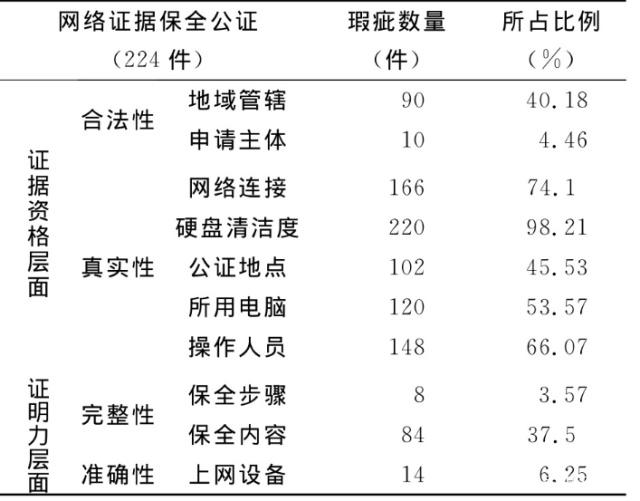
There are three main reasons for the aforementioned defects: First, the notarization, recognition, and use of online evidence are lagging behind in legislation, lacking clear laws and regulations governing the notarization of online evidence. Second, notaries themselves have shortcomings in technical skills and experience in notarizing online evidence. Third, the characteristics of online evidence itself.
For the notarization of online evidence, procedural issues are key to the effectiveness of online evidence preservation notarization. Issues mainly focus on whether the notarization method and environment are appropriate, whether the preservation procedures are rigorous, and whether the preservation content is specific [2]. The main reasons for defects in online evidence preservation notarization include the difficulty of obtaining evidence due to the characteristics of online evidence itself, a lack of knowledge about online evidence preservation, and a lack of comprehensive legal protection for online evidence preservation notarization activities [3].
With the increasing use of online evidence in judicial practice, the quality of online evidence notarization in intellectual property cases has greatly improved. Even evidence solidified by new tools such as timestamps by parties with a strong sense of rights has been recognized by the courts. 2. Determining the Publication Time and Scope of Online Evidence
In many civil cases, especially intellectual property infringement disputes, the determination of the publication time and scope of online evidence is often a focal point of contention. Currently, the modification mechanisms of similar platforms vary significantly, thus requiring specific analysis based on the specific platform’s mechanism.
First, permanently archived webpage information provided by some highly credible websites currently carries strong credibility. These websites primarily include: the Internet Database, a non-profit organization based in San Francisco, USA; periodically archived content from Microsoft Bing search engine; and timestamp services provided by trusted timestamp verification centers. For information stored in Internet databases, assistance from lawyers outside of mainland China or Hong Kong is required to obtain evidence and provide notarized documents. Webpages periodically archived by Microsoft Bing search engine can be obtained independently and notarized. Timestamp services provided by trusted timestamp verification centers also possess strong evidentiary value regarding the publication time, and the cost is lower than notarization.
Second, information published by some highly credible websites, such as government websites, industry association websites, large research institute websites, educational institution websites, and well-known commercial websites, generally carries high credibility. The release time of some third-party platforms cannot be modified, and can usually be reasonably trusted. For example, in the case of Tencent Video mentioned at the beginning of the article, in the dispute between Guangzhou Dream Palace Animation Technology Co., Ltd. and Guangzhou Aiduomi Animation Technology Co., Ltd. for infringement of utility model patent rights, the Supreme People’s Court held [4]: the video was notarized and extracted from the third-party Tencent Video website, and the release time indicated therein was objective. Aiduomi Company was able to provide corresponding evidence to prove the release time of its promotional video for its products. In the absence of any contrary evidence from Aiduomi Company to overturn this, the release time of the video should be reasonably trusted. Platforms that cannot modify the release time also include WeChat public accounts, Sina blogs, Sohu blogs, QQ space, etc. In the early days, WeChat public accounts did not provide modification after release. Currently, WeChat public accounts provide one modification opportunity, but the modification date will be made public after the release date. The release time of Sohu blogs and Sina blogs is automatically generated by the system and cannot be modified. Its public scope can be changed from private to public, but the no-public time and public scope are relatively reliable. QQ space/album does not provide a way to modify the public time setting, and its public time is relatively reliable. Third, if online evidence is generated on websites lacking strong credibility, its probability of being supported is low. Some websites allow content to be modified independently, and no record of these modifications can be kept, such as Youku videos and NetEase blogs; therefore, the time and scope of their publication cannot be supported. Another situation is that some websites have review mechanisms, such as Baidu Wenku. Articles published on Baidu Wenku require review, although the review time is usually short. However, the published date is not the date the public can access the evidence, thus the time and scope of the evidence’s publication are flawed.
3. Common Authentication of Online Evidence
In current judicial rulings, the standards for determining the authenticity of online evidence are not strict, provided there are no obvious flaws in the notarization. Notarized evidence is usually considered authentic in the absence of contrary evidence.
Regarding WeChat chat record evidence, the author reviewed 23 civil judgments from the Supreme People’s Court concerning the authenticity of WeChat chat records. In 20 cases, the opposing party did not object to the authenticity of the WeChat chat records. In 1 case, the court did not accept the evidence because it could not prove the relevance. In 2 cases, although the opposing party did not acknowledge the authenticity of the WeChat chat records, the court confirmed the authenticity of the online evidence based on the fact that the notarization of the evidence was flawless and the opposing party did not raise any counter-evidence.
As for video evidence, such as Douyin video evidence, it is often questioned by the opposing party. However, in the case of Jiangsu Zhenqian Electromechanical Technology Co., Ltd. and Jiangsu Liangshi Building Materials Technology Co., Ltd.’s infringement of utility model patent rights, the Supreme People’s Court held [5] that: Douyin is a short video social software in the Internet environment, not the internal storage video of a mobile phone. The notarized certificate has verified the source of the mobile phone and the owner’s information, and has conducted an on-site inspection of the mobile phone. The entire operation process from turning on the mobile phone, entering the login password, logging into the Douyin account, and conducting relevant searches was under the supervision of the notary. Therefore, the notarization process of finding the video in question and taking photos and videos complies with the requirements of the notarization procedure. The notarized content should be considered true and valid in the absence of contrary evidence sufficient to overturn it.
As for blog evidence, there are many cases in judicial practice where it has not been supported. The main reasons for evidence not being supported include: lack of relevance between the evidence and the facts to be proven; some blog editing mechanisms prevent them from effectively preserving modification traces, making it impossible to confirm the blog’s publication date; the blogger’s true identity cannot be confirmed; and serious flaws exist in the notarization process of the blog evidence. Supported evidence, on the other hand, usually involves notarized materials forming a complete chain of evidence, and the opposing party does not present any counter-evidence.
Summarizing all types of online evidence, we can draw the following three conclusions: First, online evidence usually requires notarization, and flaws in the notarization process should be avoided as much as possible. Second, notarized online evidence materials need to be as complete as possible and comply with the three principles of admissibility, relevance, and authenticity of evidence. Third, as the opposing party, merely raising verbal objections is insufficient; counter-evidence is required.
4. Summary and Outlook
With the popularization of the internet, more and more information and communication take place online, making online evidence an important type of evidence. The importance of online evidence in cases cannot be ignored. However, due to the special nature of online evidence, its collection, preservation, and presentation also present certain difficulties. Therefore, when collecting and using online evidence, one should be familiar with the standards for evidence recognition in judicial practice to ensure the legality, authenticity, relevance, and evidentiary purpose of the evidence.
References:
[1] Ling Song, Ling Zongliang. The Real Dilemma and Improvement Suggestions of Notarization of Online Evidence Preservation—Taking the Intellectual Property Trial Practice of the Huangpu District People’s Court of Shanghai as a Sample [J]. Journal of Chongqing University of Posts and Telecommunications (Social Sciences Edition), May 2012, Vol. 24, No. 3: 31-37.
[2] Cui Guiqing. A Brief Analysis of Notarization of Online Evidence Preservation [J]. Vitality, No. 3, 2019: 246.
[3] Li Xiaoxu. Risks and Countermeasures under the Construction of Notarization of Online Evidence Preservation [J]. Legal System Review, April 2021: 110-111.
[4] Supreme People’s Court, Civil Judgment No. 630 of 2021.
[5] Supreme People’s Court, Civil Judgment No. 390 of 2021.