
Yu Chunbo
The Chinese version was first published on iplead, Date: Apirl 16, 2024
Machine Translated by Google
This article conducts an exploratory study on the legal protection of essentially derivative varieties, drawing on the experiences of other countries that implement legal protection for essentially derivative varieties.
my country’s plant variety protection system has been established for more than 20 years. Under the background of the country’s increasing emphasis on intellectual property protection, the protection level of plant variety rights has been continuously improved. Nevertheless, with the rapid development of breeding technology and testing technology, the protection of plant variety rights still faces some new problems. In order to encourage original innovation in breeding and solve the serious problem of seed homogenization from the source[1], the Seed Law implemented on March 1, 2022 established the substantial derived variety system. However, the State Council has not yet stipulated the implementation steps and methods of the substantial derived variety system. This article combines the situation of other countries that implement the legal protection of substantial derived varieties to conduct an exploratory study on the legal protection of substantial derived varieties.
01
What is a substantial derived variety and its protection
The concept of “substantial derived variety” (EDV) first appeared in the 1991 text of the International Convention for the Protection of New Varieties of Plants (UPOV)[2]. my country has joined the convention in 1999. The purpose of introducing this concept in UPOV is to prevent the production and operation of a plant variety (IV) after making minor modifications, and to prevent the holder of the rights to the original plant variety from sharing the profits, which would result in substantial unfairness. Chinese expert Cui Yehan used the following diagram to intuitively introduce the basic concept of substantial derivative varieties[3].
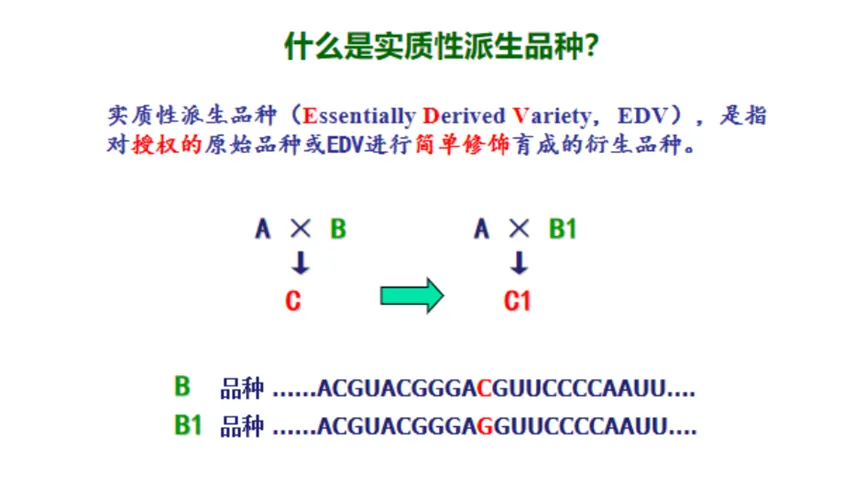
The protection of substantial derivative varieties primarily focuses on protecting the rights of the original plant variety to which the substantial derivative variety originates. The new Seed Law stipulates that, in the absence of legally prescribed preclusions, the production, propagation, treatment, offering for sale, sale, import, export, and storage of propagating material for the purpose of propagation of the substantial derivative variety, as well as the reuse of propagating material of the substantial derivative variety for commercial purposes in the production of propagating material of another variety, all require the permission of the original variety’s variety rights holder. Furthermore, actions involving the unauthorized use of propagating material from the substantial derivative variety also require the permission of the original variety’s variety rights holder.
When a plant variety primarily originates from the original variety, or from other substantial derivative varieties primarily originating from the original variety, while retaining the expression of the basic characteristics of the original variety’s genotype, the variety is often considered a substantial derivative of the original variety. The determination of substantial derivative varieties often relies on molecular marker detection methods such as gene fingerprinting. Molecular markers can be used to characterize plant genetic resources and determine the similarity between plant varieties based on the genetic resource situation. For example, in December 2020, my country launched a pilot program for substantial rice derivative varieties, designating 36 units as pilot entities for the substantial derivative variety system. The stipulated method for identifying substantial rice derivative varieties was the MNP marker method, with a genetic similarity threshold of 92%. Molecular marker methods can quantitatively compare the similarity of genetic resources and have advantages such as high throughput, high map resolution, and high repeatability. Under the current circumstances, conducting molecular marker analysis helps reduce the legal uncertainty in determining substantial derivative varieties, providing a more predictable infringement risk analysis, and enabling breeders to avoid unexpected infringement risks.
02
The Urgency and Importance of Protecting Substantial Derivative Varieties
On December 25, 2023, the Ministry of Agriculture and Rural Affairs issued Announcement No. 739, which immediately attracted widespread attention and discussion from all sectors of society. The announcement included the list of enterprises holding the 84th batch of crop seed production and operation licenses in its appendix. The list includes 26 companies that have obtained licenses to produce and sell genetically modified (GM) corn and soybean seeds, specifically encompassing 37 GM corn varieties and 10 GM soybean varieties.
For a considerable period, the term “GM variety” was understood in a narrow sense as a variety of plant or animal obtained through GM technology—that is, varieties obtained by using recombinant DNA technology to create new recombinant genes outside the plant or animal genome. However, the “GM variety” that the general public is now concerned with likely includes all varieties obtained by using genetic engineering to modify genes or genomes to alter the genetic characteristics of plants and animals. Currently, publicly available information cannot distinguish whether each of the first batch of licensed “GM varieties” belongs to the narrow definition or the broader definition obtained through other genetic engineering methods. However, it is clear that varieties obtained through genetic engineering are within reach.
Currently, there are many directions in breeding using genetic engineering methods. For example, new plant breeding technologies (NPBT) use gene editing technology to selectively alter genetic changes without introducing foreign genes, simply by editing existing genes. For example, CRISPR-9 gene-editing technology enables gene transfer by cutting a gene from the same or different species and inserting it into the target location. These technologies have a very short implementation cycle, and the resulting varieties may be completely different in traits from the original varieties.
Let’s consider this scenario: A traditional hybridization breeding team spends at least a year selecting and cultivating male and female parents in the fields. The following spring and summer, they conduct hybridization in northern fields. If successful, they select superior varieties for seven generations of self-pollination, spending at least four more years in the north and autumn and winter in Hainan. After the new variety is developed, they conduct DUS field observations and participate in improved variety experiments, spending another two years in the fields. After seven or eight years, they finally successfully breed a new variety A with significant market potential. This new variety A has only been promoted for a year when other breeders use NPBT technology to launch another new variety, A1, based on A. The new variety A1 has taller plants and larger ears of grain compared to the new variety A. Everyone rushes to buy and plant the new variety A1. In terms of traits, new variety A1 is different from new variety A. Without a substantial derivation system, the breeding team of new variety A would not receive any legal protection. This would obviously be a major blow to the original innovation of breeding. After the establishment of the substantial derivation system, new variety A1 cannot be commercialized without the permission of the breeding team of new variety A. At this time, the breeding team of new variety A and the breeding team of new variety A1 will share the property rights of new variety A1. In addition, the homogenization of crop varieties in my country is serious, which seriously restricts the development of agriculture in my country. Taking wheat as an example, more than 40% of the varieties promoted in Shandong Province are similar to Jimai 22, more than 40% of the varieties promoted in Henan Province are similar to Bainong 207 and Zhoumai 22, more than 30% of the varieties planted in northern Jiangsu Province are similar to Huaimai 22, and more than 30% of the varieties planted in southern Jiangsu Province are similar to Yangmai 20. As a result, my country’s wheat production has had bumper harvests year after year, but the quality and variety cannot meet the diversified needs of consumers. In 2021, my country imported nearly 9.77 million tons of high-quality special-purpose wheat grains[4]. Against this backdrop, establishing a substantial derivatives system can encourage breeding companies to focus more on original innovation, rather than modifying and improving existing plant varieties.
03
Challenges of the Substantial Derivatives Protection System
Undoubtedly, the protection of substantial derivatives is a legal issue, but its characteristics are closely related to breeding and testing technologies, thus presenting numerous uncertainties and challenges. At its 57th session on October 27, 2023, the UPOV Council adopted a new Interpretive Statement on Substantial Derivatives, replacing the version adopted in 2017. The new Interpretive Statement underwent four years of discussion, during which consensus was reached on many controversial issues.
The substantial derivatives system, recognizing the significant contribution of breeding work on the original plant variety to substantial derivatives, holds that the rights holders of the original plant variety should have the right to economically benefit from the commercialization of substantial derivatives. This prevents breeders from simply using genetic technology to modify already protected plant varieties for commercialization, thereby producing improved varieties. However, this is not intended to prevent breeders of substantially derived varieties from obtaining variety rights protection for substantially derived varieties.
If the determination of substantially derived varieties is overly complex, it will raise many legal issues and uncertainties. For example: what constitutes “primarily derived”? Does a substantially derived variety possess the “fundamental characteristics” of strong similarity to the original variety? What degree of similar genetic characteristics is sufficient to determine if a variety is substantially derived? Currently, specific methods and standards vary around the world, making the protection of substantially derived varieties a complex legal issue.
The lack of clarity in the substantially derived variety system has led to significant controversy in some international cases. For example, there has been a long-standing dispute between the citrus varieties “Nadorcott” and “Tango,” specifically regarding whether “Tango” is a substantially derived variety of “Nadorcott.” In a related case in 2021, the King of Morocco (the variety rights holder of “Nadorcott”) and a Spanish agricultural company engaged in a series of lawsuits in the European Court of Justice regarding alleged unauthorized production of the variety. The United States, Australia, and South Africa have also examined whether Tango is an EDV, and the UK Plant Variety Office has examined whether Tango is a protected independent variety[5]. Currently, the determination of substantial derivative varieties relies primarily on molecular marker technology. However, molecular marker technology is a constantly evolving tool, and technological changes have impacted the ongoing debate regarding the scope of intellectual property protection for substantial derivative varieties. The advantage of molecular marker technology is that it introduces a higher degree of scientific certainty. However, with technological updates, the results of testing often change, leading to fundamental changes in the determination. Critics also argue that breeders need simple rules that are easy to understand and enforce[6]. Some argue that the actual contribution ratio of the initial variety and substantial derivative should be examined based on the expression of its essential characteristics. Others suggest that other licensing systems (such as SEP) could be used as a reference, or even that industry-standard methods for plant genetic resource licensing and model contract terms could be developed based on the Nagoya Protocol. Some argue that the burden of proof should be reversed in cases involving substantial derivative varieties, as breeders of the substantial derivative varieties possess more authentic evidence of varietal origin. In this context, the importance of original breeding records as evidence is greatly enhanced. It’s conceivable that when molecular marker results are not unique or are disputed, original breeding records become crucial evidence of varietal origin. This presents higher demands and challenges for breeders in my country. I once compiled original breeding records provided by veteran breeders, among which the key evidence, the field records, were handwritten by multiple people, the handwriting was difficult to decipher, and the language contained some logical flaws. When this evidence was submitted as evidence in a lawsuit, its authenticity was questioned by the opposing lawyer. Future breeding companies and individuals should establish a complete breeding record management system, and consider using evidence preservation platforms to pre-preserve breeding records, proactively avoiding ownership disputes and infringement risks related to substantial derivative varieties.
04
Summary and Outlook
Agricultural and forestry production plays a crucial role in meeting our society’s material needs. The protection of new plant varieties is not only a legal system, but also, to a large extent, a social, economic, and scientific advancement. Crucially, innovation in plant breeding should receive appropriate incentives, which requires updating and redefining the concept and protection of substantial derivative varieties. Currently, my country’s new Seed Law has established a protection system for substantial derivative varieties, which is of great significance for protecting the achievements of seed industry innovation, encouraging agricultural enterprises and research institutions to invest more in seed industry innovation, and helping to improve my country’s seed industry innovation capabilities and enhance the core competitiveness of my country’s agriculture and forestry.
Notes
[1] Standing Committee of the National People’s Congress, Explanation on the Draft Amendment to the Seed Law of the People’s Republic of China, August 17, 2021.
[2] International Union for the Protection of New Varieties of Plants, 1991 text of the International Convention for the Protection of New Varieties of Plants, March 1991.
[3] Celine, Ten Questions and Answers on the Substantial Derivative Variety System, China Flower News, April 18, 2023. [4] Fu Xueli et al., “China Seed Industry”, Issue 2, 2023, pp. 20-23.
[5] Joel Smith. As gene editing techniques come to the fore in the UK and elsewhere, industry increasingly needs clarity on the breeder’s exception to plant variety rights. first published in May 2022, on IAM media.com
[6] Bostyn SJ. Plant variety rights protection and essentially derived varieties: A fresh proposal to Untie the Gordian Knot. GRUR International. 2020;69:785-802. DOI: 10.1093/grurint/ikaa094