
Yu Chunbo
The Chinese version was first published on iprdaily.cn, Date: September 28, 2024
Machine Translated by Google
“This article analyzes several typical issues concerning time limits and timing in patent invalidation proceedings, hoping to stimulate further discussion.”
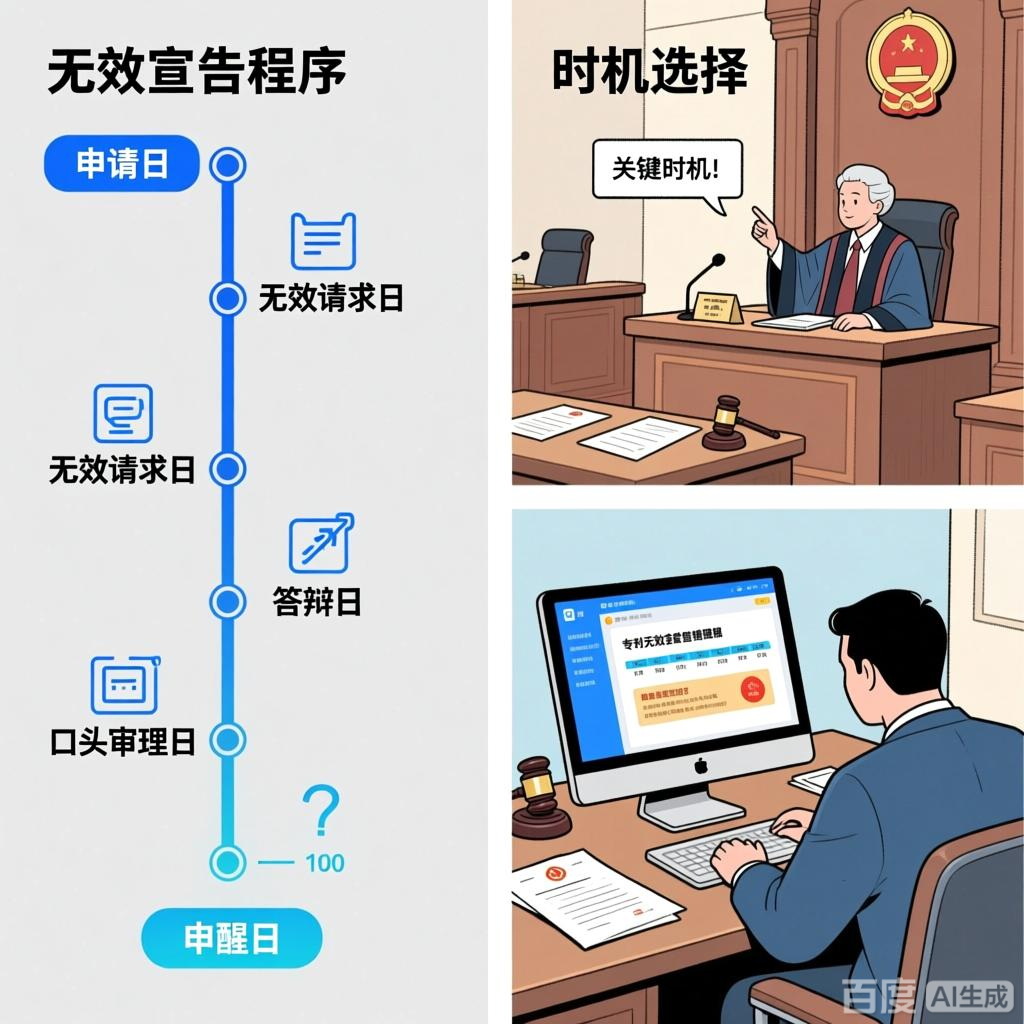
The Patent Law stipulates that after a patent is granted, any entity or individual may request its invalidation. In practice, requesters for invalidation are often defendants in patent infringement lawsuits, respondents in patent administrative investigations, or competitors with a high risk of infringement. They hope to eliminate the patent right to fundamentally resolve ongoing or potential disputes. Therefore, patent invalidation proceedings involve significant economic interests and can even determine the survival of a company. However, in such an important administrative procedure, issues of time limits and timing often lead to losses of the parties’ substantive rights. This article analyzes several typical issues concerning time limits and timing in patent invalidation proceedings, hoping to stimulate further discussion.
I.
Time Limit and Timing for Requesters to Add Grounds
According to the principle of request, patent invalidation proceedings are initiated based on the requester’s request. Therefore, when filing an invalidation request, the requester must simultaneously state the grounds for the invalidation. The grounds mainly refer to which article and clause of the Patent Law the target patent violates, and why the target patent violates that clause. For the novelty and inventiveness clauses, what combination of evidence should be used to prove that the target patent lacks novelty or inventiveness. After filing grounds for invalidation, the requester has the opportunity to add grounds, but this must be done within a certain timeframe and at a specific time.
After filing an invalidation request, the requester can add grounds for invalidation within one month. After adding grounds, a detailed explanation of the added grounds must be provided within one month of the filing date. Generally, no more grounds can be added after one month. However, there are two exceptions.
The first exception is when the patentee amends the claims of the target patent by means other than deleting claims. In this case, the panel will specify a response period in the notification of document transfer, within which the requester can add grounds for invalidation. This specified period is usually one month. The second exception is when the requester can change grounds for invalidation that are clearly inconsistent with the submitted evidence. This generally addresses obvious typographical errors in the invalidation request.
Given the aforementioned importance, grounds for invalidation are usually not omitted from an invalidation request. However, in some special circumstances, requesters are prone to making basic mistakes. For example, some petitioners still use the commentary method of dependent claims for independent claims that appear later in the claims, which may lead to omissions in the evidence combination. In the “thermal insulation pad” case, the panel held that the evidence usage method of claim 1 cannot be automatically incorporated into the invalidation grounds of claims 11 and 12. In the written opinion regarding the invalidation grounds of claims 11 and 12, the petitioner neither identified the closest prior art nor the distinguishing technical features and their commentary method. The evidence usage method of claims 11 and 12 raised by the petitioner in court also exceeded the prescribed time limit, so the panel did not review it [1].
II.
Time Limit and Timing for Petitioners to Submit Evidence
After filing an invalidation request, the petitioner may supplement evidence within one month. After supplementing evidence, the petitioner needs to explain the relevant invalidation grounds in conjunction with the evidence within one month from the date of filing the invalidation request. After one month, it is generally not possible to supplement evidence. If the evidence submitted is in a foreign language, a translation needs to be submitted within the above time limit. There are also three exceptions for supplementing evidence. The first scenario is that the patentee submits counter-evidence, and the State Intellectual Property Office, upon receiving it, forwards it to the requester. The forwarding notification usually includes a one-month deadline within which the requester can supplement evidence in response to the counter-evidence. The second scenario is that evidence of common general knowledge can be supplemented before the conclusion of the oral hearing. The third scenario is that both parties can request an extension in writing, and the panel will decide whether to grant it. The *Patent Examination Guidelines* stipulate that if denying an extension would be clearly unfair, an extension should be allowed. However, in practice, allowing extensions is rare.
Whether evidence exceeds the deadline for submission is often a point of contention in oral hearings. In the case of “A System Interface Design Method,” the requester submitted the book *Machine Intelligent Face Engineering* in court, explicitly stating that it was submitted as evidence of common general knowledge. The patentee argued that the book was not common general knowledge evidence, but prior art, and that this evidence exceeded the deadline and should not be accepted. The panel of judges believed that the requester clearly submitted the book as evidence of common knowledge, and the title page of the book clearly stated that it could be used as a teaching reference book, so it belonged to the category of common knowledge evidence. Therefore, the time limit for presenting the book as evidence was before the conclusion of the oral hearing debate, and the requester’s evidence presentation did not exceed the time limit and should be accepted [2].
III.
Time Limit and Timing for Patentee to Amend Claims
For invention and utility model patents, the patentee can amend the claims under the constraints of the amendment principle. There are four ways to amend: deleting claims, deleting technical solutions, further limiting the claims, and correcting obvious errors. The time limit and timing for the above four amendment methods are different.
For deleting claims and deleting technical solutions included in claims (a claim does not necessarily have only one technical solution, but may include multiple parallel technical solutions), it can be done before the examination decision is made. That is to say, the patentee can waive some rights in almost the entire invalidation procedure.
For the other two amendment methods, amendments need to be made within the response period in three situations, and the response period is generally one month. The first situation is for invalidation requests, that is, within one month from the date of receipt of the invalidation request. The second scenario involves amendments made by the requester regarding additional grounds for invalidation or supplementary evidence, within one month of receiving the supplementary opinions and evidence. The third scenario involves invalidation grounds or evidence introduced by the panel that were not mentioned by the requester; this is less common. If these amendment opportunities are missed, the amendments to the claims will not be accepted.
In the case of the “Electric Heat Tracing and Insulation Box for Valve Instruments,” the State Intellectual Property Office accepted the aforementioned invalidation request on July 14, 2022, and forwarded the invalidation request and copies of the evidence to the patentee. Both the patentee and the requester submitted their opinions on the invalidation request. The panel of the State Intellectual Property Office forwarded the requester’s statement of opinion to the patentee on October 10, 2022. The patentee submitted its statement of opinion on November 7, 2022, and simultaneously amended the claims, further limiting claim 1. In this case, the requester did not submit any additional grounds or evidence, and the panel did not introduce any new grounds or evidence ex officio. Therefore, the deadline for amending the claims in a further limited manner is one month after receiving the invalidation request, that is, the amended claims and the amendment comparison page should be submitted before August 14, 2022. The panel of judges in the case informed both parties in court that the patentee’s amendment to the claims exceeded the prescribed time limit and was therefore unacceptable [3].
IV.
The deadline and timing for the patentee to submit counter-evidence
In the invalidation proceedings, the patentee may submit counter-evidence. Similar to the requester, evidence of common knowledge can be submitted before the end of the oral hearing, while other evidence should be submitted within the response deadline, otherwise it may not be accepted.
In the aforementioned case of “a system interface design method”, the patentee submitted 24 counter-evidences. Among them, regarding counter-evidence 1-4, the requester had no objection to its authenticity and publication time, and the panel of judges recognized its authenticity, which could be used as evidence to prove the patentee’s claims. Regarding counter-evidence 5-24, the requester argued that it exceeded the time limit for submitting evidence and should not be accepted. The panel held that in this case, the panel forwarded the requester’s statement of opinion and supplementary evidence to the patentee on August 3, 2023, with a specified deadline of one month after receiving the forwarding notice. That is, the patentee should have responded and provided evidence before September 18, 2023. However, the patentee submitted counter-evidence 5-24 on October 1, 2023, which exceeded the specified deadline and was not evidence used to prove common knowledge of relevant technical terms. Therefore, the panel did not consider counter-evidence 5-24 [2]. It should be noted that after the patentee submits counter-evidence, the requester will have the right to supplement evidence in response to the counter-evidence. The specific deadline for the requester to supplement evidence is the deadline specified by the panel in the notification of receipt of the counter-evidence, which is generally within one month. Image V. Summary In the patent invalidation procedure, the patentee has the right to state opinions and provide evidence. However, in practice, many parties miss deadlines and opportunities, resulting in either wasted time and inefficiency, or irreparable damage to their property rights. Adhering to statutory deadlines and opportunities ensures the full protection of patent holders’ legitimate rights. Studying statutory deadlines and opportunities also ensures the transparency of patent invalidation proceedings, providing clear guidelines and expected outcomes for all parties, reducing uncertainty and points of contention, and enabling them to participate more rationally in the patent invalidation process.
References:
[1] State Intellectual Property Office, Decision on Invalidation Request No. 560183.
[2] State Intellectual Property Office, Decision on Invalidation Request No. 566856.
[3] State Intellectual Property Office, Decision on Invalidation Request No. 59443.