
Yu Chunbo
The Chinese version was first published on iprdaily.cn, Date: October 16, 2024
Machine Translated by Google
“This article introduces some pain points in the practice of evidence retrieval in patent invalidation requests, from macro to micro perspectives.”
In patent infringement litigation, the key to resolving the issue for the defendant often lies in whether they can invalidate the plaintiff’s patent through a patent invalidation request, thus achieving a decisive victory. The success of a patent invalidation request hinges on evidence retrieval. For most patent invalidation cases, the availability of evidence is crucial; good evidence greatly increases the chances of invalidation. Conversely, if the evidence is poor, the patentee can maintain the validity of their patent.
PART.01
Setting the Search Target
The Chinese definition of “search” is: to examine and search (books, documents, etc.). I often compare patent invalidation evidence retrieval to finding something. The common view is that the difficulty in patent invalidation evidence retrieval lies in the vast scope of the search, including Chinese patents, foreign patents, Chinese documents, foreign documents, books, and published evidence of use, etc., equivalent to finding a needle in a haystack. This view is correct because the search scope is indeed vast. However, this view is also incorrect. Invalidation targets a single granted patent; all petitioners are searching for a needle in a haystack, but nearly half of the petitioners still find the needle, achieving their goal of invalidating the patent. Therefore, we should discuss subjective factors more.
The first easily overlooked issue is the setting of the search target. One of the biggest differences between patent searching and finding things in daily life is that what we’re looking for in daily life is very specific and concrete. For example, if we’re looking for a glass, we all know its shape and characteristics. However, the target of a patent search is abstract. If we mechanically and blindly conduct the search, we often achieve little.
For example, in the invalidation case of the “waterless eco-toilet” patent, the content of claim 1 of the target patent is: “A waterless eco-toilet, characterized in that the toilet comprises a whole, the whole comprising a core fecal-urine separation part and a fecal fermentation device, the fecal-urine separation part comprising the fecal-urine separation device, a tilted sliding plate (1) installed in the shell, the sliding plate (1) having one side relatively lower and one side relatively higher, a urine outlet (11) on the relatively lower side of the sliding plate, a toilet opening on the shell, a scraper at the rear of the shell, i.e., on the relatively higher side of the sliding plate, the sliding plate is powered by extending…” The shaft connects to the power unit, which drives the slide plate to move back and forth; the urine-feces separation unit is located in the middle of the toilet; above the slide plate is the toilet lid (16); below the slide plate is the fecal fermentation device (15), and the urine outlet at the front connects to an external urine treatment tank, which is located at the front of the toilet and connected to the toilet by a snap fastener; the urine treatment tank also serves as a step platform; the urine treatment tank contains a heating device. Claim 1 claims to protect a waterless eco-toilet. Some searchers have focused their efforts on searching for eco-toilet products, but have not made any breakthroughs for a long time.
In fact, an analysis of the claims reveals that the toilet itself has not undergone significant improvements. For example, the technical features related to the toilet lid, fecal fermentation device, urine treatment tank, snap fastener, and step platform are all existing technologies or common knowledge. The actual inventive point of this case is the specific structure of the urine-feces separation device, i.e., the underlined part in the previous paragraph. Therefore, finding the same urine-feces separation device provides technical inspiration for improving existing technologies. In fact, once the key points of the case are accurately grasped, the search for this evidence is not difficult. The key evidence in this case is the Chinese invention patent with publication number CN101524255A, entitled “Urine and Feces Separator”. Using the ecological toilet, which is common in the prior art, as the closest prior art, and combined with the technical inspiration given by the above evidence, the State Intellectual Property Office declared the target patent invalid in its entirety [1].
PART.02
Evidence Screening
In the Romance of the Three Kingdoms, Cao Cao suffered a famous defeat called “The Battle of Puyang against Lü Bu”. Cao Cao fled from the south gate to the north gate of Puyang City and happened to run into Lü Bu riding towards him. It was night and relatively dark. Lü Bu struck Cao Cao’s helmet with his halberd and asked, “Where is Cao Cao?” Cao Cao said, “The one riding the yellow horse is ahead.” As a result, Lü Bu actually went to chase after the person riding the yellow horse. In evidence retrieval, this situation is also quite common. Many times, the searcher has already seen the usable evidence but has not recognized it.
For example, in the “disc shell” case, the key point of the target patent is that “the interior of the disc shell (3) has a groove (10) formed along its periphery, the groove (10) has a continuously increasing radius in the circumferential direction, and the increasing radius continues to the outlet (8), the outlet (8) is tangentially arranged as a direct continuation of the groove (10)”. The requester filed three invalidation requests in succession before achieving the goal of invalidation. In the invalidation decision that declared the target patent completely invalid, the closest prior art used by the requester was the cited document of the target patent family patent. The comparison between the target patent and the accompanying drawings is as follows:
Target Patent
Evidence
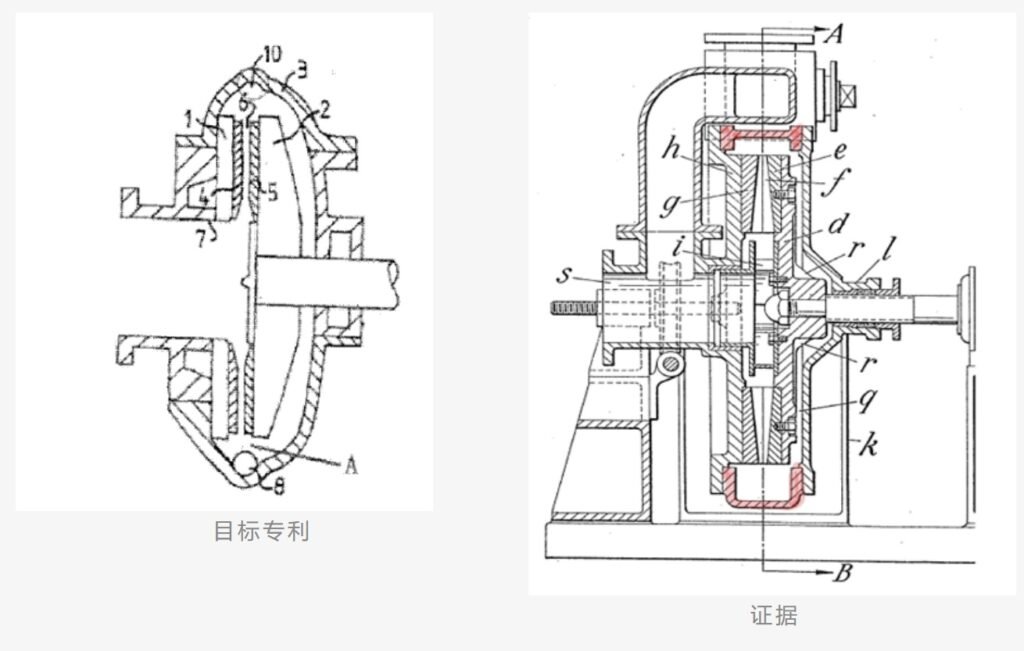
In this case, the inventive concept of the evidence itself is completely different from that of the target patent. At the same time, the technical features related to the target patent disclosed in the evidence are not disclosed in text, but are directly and unambiguously disclosed in the drawings. Many searchers cannot accurately understand the content disclosed in the drawings after seeing them. This evidence was not used in the first two invalidation requests in this case [2].
PART.03
Selection of Patent Evidence Database and Search Strategy
In patent invalidation cases, the most commonly used evidence is the patent publication/announcement text. Currently, some AI search and semantic search tools have been used in commercial databases. However, the mainstream patent evidence search tools are still traditional Boolean search tools, such as commercial databases like the Derwent Innovations Index and official free databases like the EPO of the European Patent Office and the patent search system of the State Intellectual Property Office of China. The scope of each database has certain differences. Even under the “five-office interconnection” situation, the data range retrieved by the same search formula is different between the official search databases of the US Patent Office, the European Patent Office and the State Intellectual Property Office of China[3].
Therefore, different search strategies need to be selected for different technical solutions. For example, for the search of target patents such as traditional Chinese medicine and related processes and equipment, Chinese patents should be the focus. For example, for the search of target patents related to high-precision machine tools, Japanese patents must be considered. For the search of Japanese patents, Japanese patent databases need to be considered. There are three main reasons. First, Japan’s patent classification system is quite unique. In addition to the IPC and CPC classification systems, the Japan Patent Office (JPO) has established a unique FI and FT (F-term) classification system. The FI and FT (F-term) classification systems have very distinct characteristics, which are very helpful for quickly and accurately searching Japanese patents. Second, the JPO’s patent database undoubtedly has the most comprehensive coverage of early domestic patents. Third, the publication numbers of Japanese patents are quite special. Japanese publication numbers begin with JP (Japanese patents published after 2000), JPH (H representing the Heisei era), or JPS (S representing the Showa era). Many patent search systems require supplementing the publication number, which is technically challenging and extremely easy to miss. For example, when searching for target patents related to centrifugal compressors, it is essential to pay attention to European patents; EPO search tools are indispensable. In fact, EPO search tools are widely used in global patent searches.
PART.04
Searching for Design Patents
Design patents protect new designs that are aesthetically pleasing and suitable for industrial application, made in whole or in part by the shape, pattern, or combination thereof, as well as the combination of color with shape and pattern, of a product. In practice, many design patent applicants tend to protect the shape rather than the product’s pattern, color, or various combinations. Even regarding shape alone, it is difficult to find a design with an exactly identical shape in prior patent literature. In fact, for design patents, unless it is a direct, unmodified copy, it is impossible to obtain a completely identical design.
In this respect, design patents are completely different from inventions and utility models. Newton and Leibniz were able to independently discover the Newton-Leibniz law on opposite sides of the English Channel. When a technical solution is nearly mature, it is like two apples falling from an apple tree in autumn—it is quite common. In the fields of inventions and utility models, the emergence of independent similar solutions may be a result of the development of the times. However, it’s hard to imagine that two masters independently created two vases with identical shapes and patterns simply because they were made in the same era.
Therefore, for design patents, the most important evidence is public disclosure evidence, not patent evidence. Public disclosure evidence often stems from improper disclosure by the patentee before the application date. Once public disclosure evidence is established, the vases are essentially identical, making it difficult to refute the content. Public disclosure evidence refers to methods that enable the public to know the technical content, such as manufacturing, use, sale, import, exchange, gifting, demonstration, exhibition, and bidding. As long as the relevant technical content was made available to the public through these methods before the target patent application date, it constitutes public disclosure, regardless of whether the public actually knew about it.
Therefore, the focus of disputes over public disclosure evidence is often whether the disclosure time and content are sufficient to prove the disclosure of the target patent. Regarding disclosure time, information published on government websites, industry association websites, large research institute websites, educational institution websites, and well-known commercial websites generally has high credibility, and the disclosure time can usually be established. The publication time on some third-party platforms cannot be modified and is usually reasonably credible. For example, in the case of the dispute between Guangzhou Dream Palace Animation Technology Co., Ltd. and Guangzhou Aiduomi Animation Technology Co., Ltd. regarding infringement of utility model patent rights, the Supreme People’s Court held that: the video was notarized and extracted from the third-party Tencent Video website, and the release time indicated therein was objective. Aiduomi Company was capable of providing corresponding evidence to prove the release time of the promotional video for its products. In the absence of any contrary evidence provided by Aiduomi Company to overturn this, the release time of the video should be reasonably relied upon [4].
As for the use of publicly available evidence, it is often based on physical photos or videos, and the six views of the product are not disclosed. However, based on the principle of “overall observation and comprehensive judgment”, for a certain type of product, the most attention-grabbing view has a significant impact on its overall visual effect, and the overall shape also has a significant impact on its overall visual effect. If, in the feature comparison, it can be seen that the overall shape of the target patent and the evidence are the same, and the design of the most attention-grabbing view is also completely the same, these similarities make the two have basically the same overall visual effect. And the view that is not easily noticed by ordinary consumers, even if it is not disclosed by the evidence, does not affect the fact that the design of the target patent has been disclosed [5]. In other words, as long as a physical photograph reflecting the design elements of the target patent is found, there is no need to worry too much about whether the photograph reflects all views. Of course, the photograph needs to reflect the main design elements. For example, a frontal photograph of a person can identify them, but a photograph of only their back cannot accurately confirm their identity.
PART.05
Summary
Evidence retrieval in patent invalidation requests is a systematic project, and many academic monographs have systematically and comprehensively introduced this work. However, this work is a systematic project, and there are many details that need attention, both at the macro and micro levels. This article introduces some pain points in the practice of evidence retrieval in patent invalidation requests from macro to micro perspectives, hoping to serve as a starting point and provide useful reference for improving the retrieval efficiency of patent invalidation cases.
Image
References:
[1] State Intellectual Property Office, Decision on Examination of Invalidation Request No. 57521
[2] State Intellectual Property Office, Decision on Examination of Invalidation Request No. 53829
[3] Yu Chunbo and Li Ying, A comparative study on the functions of USPTO patent search tool PPUBS, China Invention & Patent (Journal of Intellectual Property Information), Vol. 20, No. 3.