
Yu Chunbo1,Li Ying2 (1. Beijing Xuanyan Law Firm, Beijing 100089; 2. Beijing Liuchen Law Firm, Beijing 100080)
The Chinese version was first published on iprdaily.cn, Date: September 27, 2023
Machine Translated by Google
“Conducting Free Exploitation (FTO) analysis in the Japanese market before a new product or technology enters the market is of great practical significance and strategic value to companies.”
Freedom to Exploit (FTO) analysis is a crucial tool for assessing patent rights and mitigating risks. Its primary purpose is to identify and address potential patent infringement risks. FTO analysis helps companies understand the R&D background, patent portfolio, and technological trends of relevant technologies, enabling them to better grasp market dynamics and technological trends. It can identify potential patent risks, such as infringement risks and technological risks, allowing for timely mitigation measures to avoid legal disputes and losses.
Due to the territorial nature of patent protection, FTO analysis is often conducted for different markets. Japan is the world’s third-largest economy and one of the world’s largest high-tech producers. The stability and strong purchasing power of the Japanese market attract many Chinese companies to conduct business there. Therefore, conducting FTO analysis specifically for the Japanese market has significant practical implications.
01 Overview of Freedom to Exploit (FTO)
FTO analysis, or Freedom to Exploit Analysis, is an intellectual property analysis tool and method designed to help companies and individuals understand the free exploitation status of their patents, thereby better managing and protecting their intellectual property.
When conducting FTO analysis, it is necessary to search and analyze relevant patents to understand their scope of protection, claims, technical fields, patent status, and other information. Then, it is necessary to conduct patent analysis on competitors or other companies in the industry to understand their technical strength, patent layout, infringement risks, etc. It is also necessary to consider the free implementation of the patent, that is, whether the patent is subject to any restrictions or constraints, and whether it can be freely implemented and used. For example, whether the patent is affected by any litigation, arbitration, disputes or other legal procedures, whether it is protected by any technical restrictions, trade secrets or other confidentiality measures, etc.
FTO analysis can provide companies with early warnings about punitive damages. In many countries or regions, patent infringement may face punitive damages. According to Article 102 of the Japanese Patent Law, punitive damages require the infringer to have intent. If the patentee wants to realize punitive damages, he/she needs to prove that the infringer has subjective intent or negligence, which can exceed the amount of damages suffered by the patentee or the exclusive implementer. In Japanese judicial practice, the judgment of subjective malice is very important. Only when the evidence is proven that the defendant has intentional or gross negligence in infringement can the court apply punitive damages[1]. Prior Freedom to Execute (FTO) analysis can, to a considerable extent, demonstrate that a company has exercised reasonable care and lacked intent or malice in infringing, thus avoiding liability for punitive damages.
02 Selection of Target Scheme for Freedom to Execute (FTO) Search
FTO analysis is typically conducted for new products or technologies entering a specific market. When a company or individual develops a new product or technology, or when a product or technology is about to enter a new market, an FTO analysis is necessary to assess whether the product or technology infringes on existing patents in that region and whether it is necessary to seek patent protection.
When a competitor’s product has filed multiple patents, and the company is concerned that its product may infringe on the competitor’s patent rights, an FTO analysis may also be necessary. This assesses whether the company’s product infringes on the patent rights of these specific competitors and simultaneously determines whether it is necessary to adjust its own patent protection strategy. Another situation where an company or individual may need to obtain technology licenses or transfers from other companies may also require an FTO analysis.
Before conducting an FTO analysis, it is crucial to identify the technical points or risk points corresponding to the target product. First, it’s necessary to understand the technological background, including the origin, development history, current status, and future trends of the relevant technologies. This helps determine the starting point and focus of the technical solution, providing a foundation for subsequent analysis. Second, the scope of the technical solution needs to be determined, including analyzing the technical solution and defining its scope and boundaries. During this process, lawyers must communicate with technical personnel to identify the key technical points involved in the product, allowing for more targeted attention to relevant details during the Free Implementation (FTO) search. Finally, potential patent risks need to be identified, including searching for patent information related to the technical solution, especially those patents highly relevant to the technical solution, and those patents that may involve infringement risks.
03 Search Scope for Free Implementation in the Japanese Market (FTO)
Before conducting FTO analysis and searching, it’s necessary to determine the patent search system to be used. Patent search systems generally fall into two categories: one is the five major patent office patent search databases that are freely available to the public, specifically the public databases on the websites of the patent offices of China, Europe, the United States, Japan, and South Korea. Among them, the China Patent Office database focuses on the inclusion of domestic patent information, allowing retrieval of all domestic invention, utility model, and design patents. The European Patent Office database mainly contains European patents, including a large amount of European patent information worldwide, as well as some international patent applications and US patent applications. I have written a paper comparing public databases and found that the European Patent Office database has the most comprehensive collection of international patents [2]. The US Patent and Trademark Office database contains US patent and trademark information, as well as some international patent applications. The Japanese and Korean Patent Office databases mainly contain all invention, utility model and design patent information of Japan and Korea, respectively. Another type is commercially purchased search databases, such as Derwent, IncoPat, himmpat, PatSnap, Patentics, and innojoy. Compared with the five major patent offices’ databases, commercial databases have more user-friendly search entry points and interfaces. Some databases can provide, for example, titles and full-text translations of foreign patents, support Chinese and English searches, and multilingual versions of information, which can help improve manual screening and recall rates, avoid missing important information, and have various data analysis functions. After selecting a search system, the scope of the search data needs to be further limited. When conducting an FTO search targeting the Japanese market, the data scope should include valid Japanese patents (including published but ungranted patent applications, and granted Japanese patents still under protection). Furthermore, to ensure recall, the data scope should also include valid PCT international patent applications, as these PCT international patent applications may subsequently enter the Japanese national phase.
When the product to be searched includes multiple risk points, each risk point needs to be searched to prevent all infringement risks. Therefore, after determining the data scope, corresponding basic search elements need to be determined for each risk point, and appropriate classification numbers and keywords should be selected to construct a search formula for each risk point. Because patent documents often describe technical content from multiple perspectives, the search needs to be continuously adjusted and expanded based on the search results. For example, it may also include descriptions of the technical problems solved, technical effects, or uses of the technical features. Therefore, the search results need to be continuously evaluated to remove data noise and find target patents related to the technology of the risk points as quickly as possible while ensuring recall. Once the target patent is found, the technical solution for the risk point needs to be compared with the independent claims of the target patent. There may be multiple independent claims in the claims document; in this case, each independent claim needs to be compared with the technical solution for the risk point to determine whether there is any infringement risk.
04. Search Characteristics for Free Implementation (FTO) in the Japanese Market
Japanese patent classification has its own characteristics. To achieve the required recall rate and reduce the possibility of missed detections, searches need to be conducted based on these characteristics. Therefore, the application of Japanese patent classification numbers is particularly important in searches targeting FTO analysis in the Japanese market.
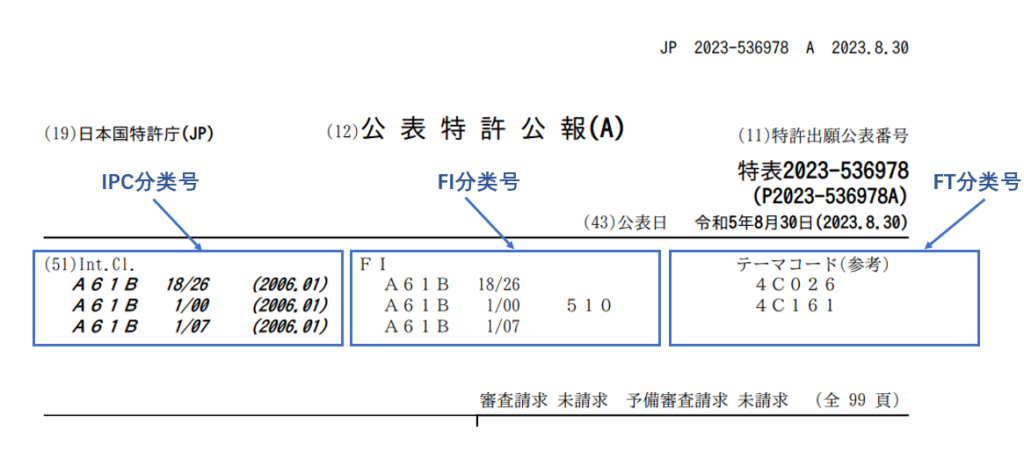
Generally, for invention and utility model patents, there are two types of Japanese patent classification numbers: one is the FI classification number. FI is a classification system unique to the Japan Patent Office, based on the IPC. It is used as a search key for domestic patent documents and is revised annually in necessary areas to function as an appropriate search key in response to technological advancements. FI generally conforms to the latest version of the IPC, but some conform to older versions of the IPC. In such cases, the FI and IPC groups may be inconsistent.
The FT (File Forming Terms) classification system is a further subdivision of the IPC classification system and the FI classification system by the Japan Patent Office. Using the FT classification system for retrieval, each subdivision reflects only about 100 existing technical documents. The FT classification system classifies technologies from multiple perspectives, such as further subdividing a specific technical field based on the purpose, use, type, environment, function, and parameters of the invention [3]. Examples of FI and FT classification numbers are shown in Figure 1.
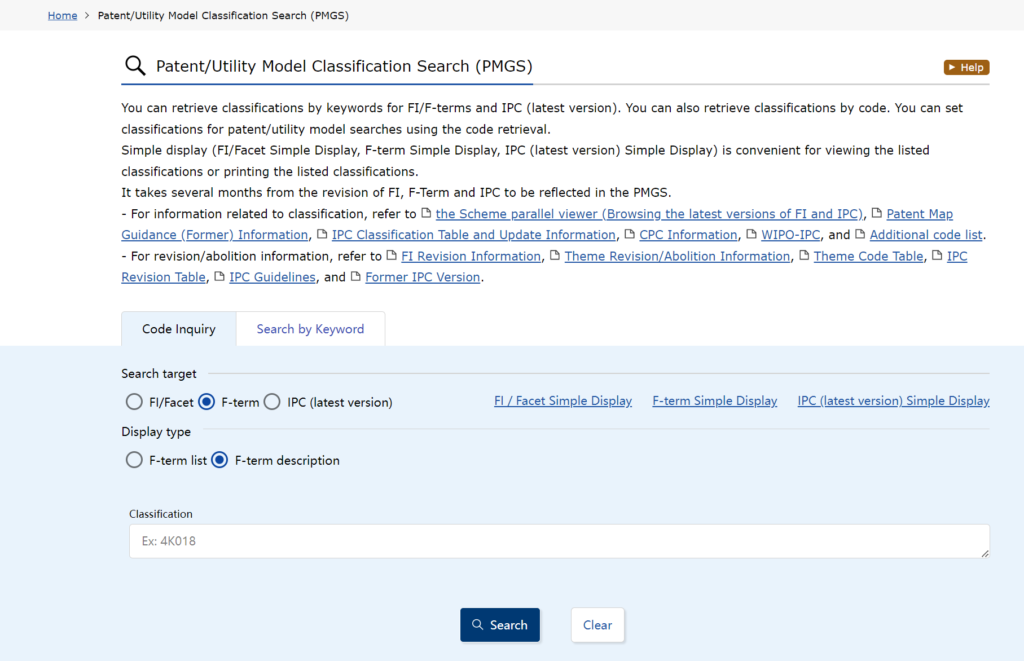
The Japan Patent Office (JPO) provides both Japanese and English versions of the FI and F-term classification tables. To obtain the English version, visit the JPO homepage and find “Patent/Utility Model Classification Search (PMGS)” under the “Patents/Utility Models” section. The URL is https://www.j-platpat.inpit.go.jp/p1101, as shown in Figure 2. Based on my experience, the fastest way to determine the FI/F-term classification number is to first determine the IPC classification number of the technology product, then find the corresponding FI classification number based on the IPC classification number, and finally find the F-term classification number that most closely matches the technical characteristics.
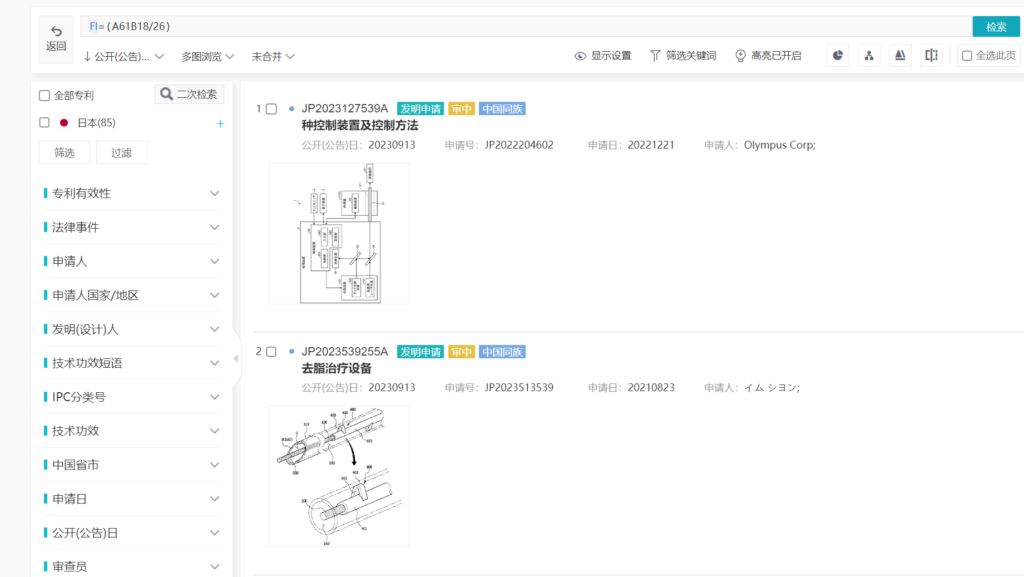
In FTO analysis targeting the Japanese market, utilizing FI/FT classification codes for retrieval is crucial. Due to differences in language conventions, Japanese patent applicants use significantly different technical terminology compared to patents from other countries, thus keyword searches carry a high risk of missed detections. FI/FT classification codes, however, provide a very detailed division of technical fields, making it easier to find the corresponding classification code for the target technical solution, thereby improving search efficiency. FI/FT classification codes can be searched not only in the Japan Patent Office database but also in numerous commercial databases, such as the Incopat database, as shown in Figure 3.
05 Conclusion
Japan attaches great importance to patent protection. The Japanese government has formulated a series of patent laws and regulations, such as the Patent Law, the Utility Model Law, and the Industrial Property Law, to protect inventions, encourage technological innovation, and promote economic development. The Japanese government has cracked down on patent infringement and has increased penalties for infringers in recent years. At the same time, Japan has also established a special intellectual property court to handle patent disputes, which has improved the judicial efficiency of patent protection.
Therefore, conducting Free Implementation (FTO) analysis in the Japanese market before new products or technologies enter the Japanese market is of great practical significance and strategic value to enterprises. In this case, enterprises should adopt the correct FTO analysis strategy, make full use of FTO analysis tools, gain a deep understanding of market dynamics and competitors’ patent status, avoid the risk of patent infringement, and formulate appropriate patent strategies to achieve sustainable development and establish a competitive advantage in the Japanese market through product and technological innovation.
References:
[1] Zhang Diwei, Research on Punitive Damages for Patent Infringement, Master’s Thesis, Graduate School of Chinese Academy of Social Sciences, April 24, 2018. [2] Yu Chunbo, Li Ying, A comparative study on the functions of USPTO patent search tool PPUBS, China Invention & Patent (Journal of Intellectual Property Information Science), Vol. 20, No. 3, pp. 5-15, March 2023.
[3] Japan Patent Office website: https://www.j-platpat.inpit.go.jp/p1101