
Yu Chunbo
The Chinese version was first published on ip ForeFront, Date: December 24, 2024
Machine Translated by Google
Preface
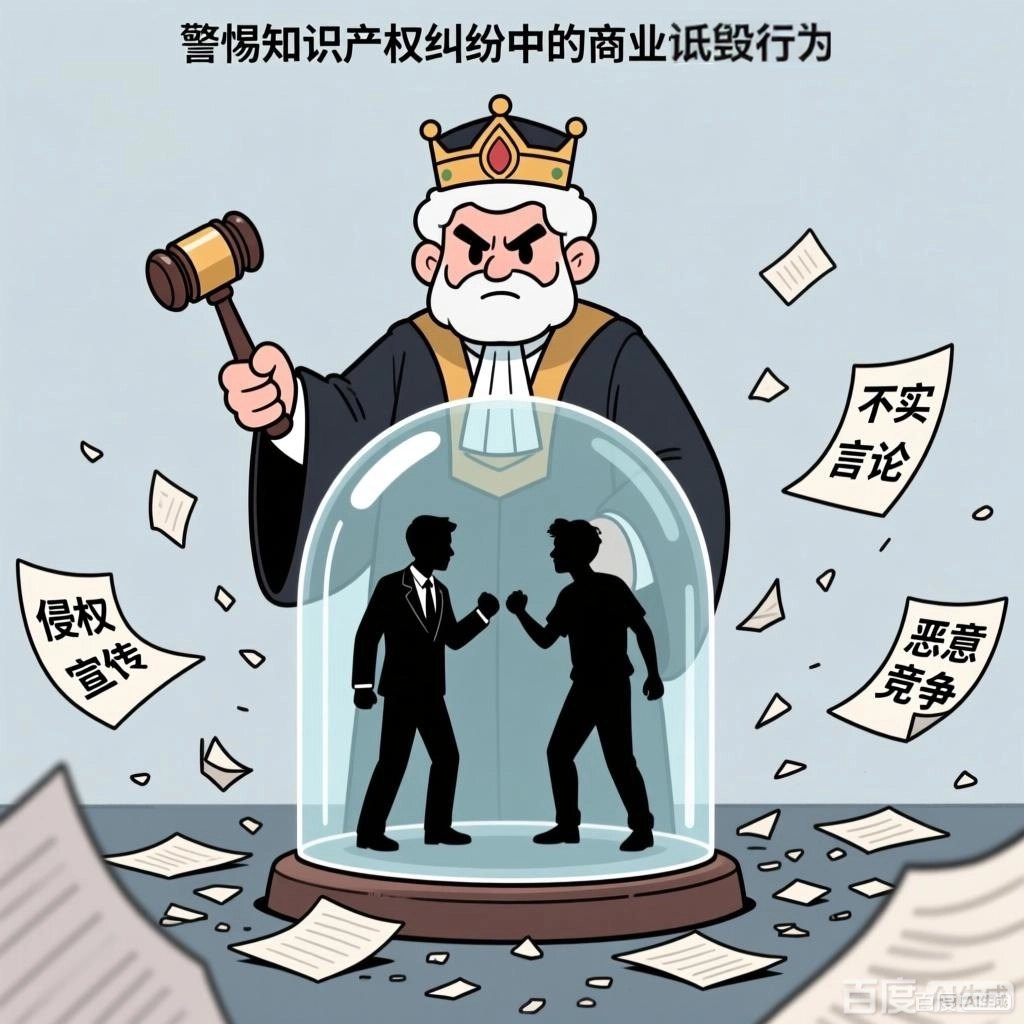
In recent years, a particularly problematic practice has frequently emerged in intellectual property disputes: commercial defamation. Some parties who engage in such acts knowingly violate the law, hoping to evade punishment, and intentionally commit these acts. More often, however, the parties lack legal awareness and are unaware of the specific circumstances and legal consequences constituting commercial defamation in intellectual property disputes. Inevitably, parties in every intellectual property dispute will sometimes express their views on the case to the outside world. Therefore, defining what constitutes commercial defamation and to what extent such information dissemination is crucial. This article analyzes several typical acts of commercial defamation in intellectual property disputes, providing a reference for parties disseminating information.
I. Overview of Commercial Defamation
Article 11 of the Anti-Unfair Competition Law of the People’s Republic of China (2019 Amendment) stipulates that business operators shall not fabricate or disseminate false or misleading information to damage the business reputation or product reputation of competitors. Article 23 stipulates that if an operator violates Article 11 of this Law by damaging the commercial reputation or product reputation of a competitor, the supervisory and inspection department shall order the cessation of the illegal act and the elimination of its impact, and impose a fine of not less than 100,000 yuan but not more than 500,000 yuan; if the circumstances are serious, a fine of not less than 500,000 yuan but not more than 3 million yuan shall be imposed.
Commercial defamation mainly refers to the act of an operator, either personally or through others, maliciously defaming or belittling the commercial reputation or product reputation of a competitor by fabricating or disseminating false facts, in order to weaken its market competitiveness and seek illegitimate gains for themselves. From the perspective of the perpetrator, those who engage in commercial defamation are usually operators in competition with the defamed party. In terms of methods, it mainly includes fabricating and disseminating false facts. “Fabricating” means creating false information unfavorable to competitors out of thin air, such as the false news about the potential danger of mobile phone explosions mentioned above. “Disseminating” means spreading this false information through various channels, such as publishing it on online platforms or spreading it orally through offline sales channels.
In commercial defamation related to intellectual property disputes, the perpetrator often has a flawed understanding. The most typical scenario is that the perpetrator does not believe the information they disseminate is false or fabricated, but objectively, the information they publish does not comply with legal regulations, harms the legitimate rights and interests of competitors, and damages their brand image. Moreover, for consumers, such false information interferes with their normal judgment, preventing them from making reasonable consumption decisions based on the truth. Simultaneously, commercial defamation also disrupts the fair competition order of the market.
Regarding legal liability, parties who commit commercial defamation may bear civil liability for damages, including compensating competitors for economic losses suffered due to the defamation. Due to the special nature of commercial defamation cases, parties who commit commercial defamation often also bear legal responsibility for eliminating the impact, typically through publishing an apology in a newspaper or on a specific website within a fixed period, with a fixed length.
II. Self-publishing information is not a legally legitimate way to protect rights
Some business operators are aware of intellectual property protection and have applied for trademarks, patents, and other intellectual property rights. However, they lack practical experience in the application of intellectual property rights. When a competitor discovers that it may have infringed on their intellectual property rights, instead of taking legal action such as filing a lawsuit or applying for administrative investigation, some companies publish information explicitly or implicitly indicating that the other party has infringed on their intellectual property rights. In such cases, their rights may not be protected, and they may even have to apologize and compensate the other party for their losses.
For example, in the “Honeycomb Non-stick Pan” case, the defendant, Bach Company, held the patent rights (patent number: ZL20131008××××.6), while the plaintiff, Supor Company, was a competitor of Bach Company. In 2019, Bach Company published a full-page advertisement in the *Yangcheng Evening News*, which included the following: “Supor: Thank you. If it weren’t for your imitation, no one would know that I am the original inventor of the honeycomb non-stick pan (patent number: ZL20131008××××.6)” and “KBH Kangbach, see you at the Guangzhou Shangri-La Hotel on October 23,” and provided a QR code. Scanning the QR code redirects to the “Kambach Official Website” (×××.com). On this website, Bach Company published a statement accusing Suppor Company of “unauthorized misappropriation of Kambach’s ‘honeycomb non-stick patent technology’ to counterfeit and sell infringing products.” Furthermore, Bach Company also conducted similar promotions on platforms such as WeChat official accounts and Weibo. On October 23, Bach Company held a “Witness Originality” patent rights protection press conference at the Manjianghong Hall on the 3rd floor of the Shangri-La Hotel in Guangzhou. The following day, Suppor Company’s stock price fell by 1.49%, while the decline in the Shanghai Composite Index and the declines in its home appliance, white goods, and small appliance sectors were not significant.
The plaintiff, Suppor Company, argues that the defendant, Bach Company’s, actions explicitly or implicitly suggest that Suppor Company infringed upon Bach Company’s patent rights, constituting commercial defamation, and should bear corresponding civil liability. Bach Company believes that the patent in question does exist, and Bach Company has filed a patent infringement lawsuit with the Hangzhou Intermediate People’s Court. The accused behavior is the exercise of its own legitimate rights. The court of first instance held that when Bach Company released the above information, there was no judicial ruling or administrative decision that determined that Supor Company had infringed on Bach Company’s patent rights; Bach Company only filed the relevant patent infringement lawsuit after the above information was released. If Bach Company wants to protect its rights, it should take legal and legitimate means such as filing a lawsuit with the People’s Court or complaining to the patent administration department, rather than publicly claiming through various channels that Supor Company infringed its patent rights before filing a lawsuit or complaint. The accused behavior obviously had a negative impact on Supor Company’s business reputation and product reputation. The court of first instance ruled that the defendant Bach Company should publish a statement in the media and platforms involved in the above behavior, such as Yangcheng Evening News, to eliminate the impact and compensate for losses of 3 million yuan. The judgment of the second instance upheld the judgment that Bach Company should eliminate the impact and compensate for losses, and added that Bach Company should immediately stop disseminating and fabricating false or misleading information [1]. 3. Do not use ineffective legal documents for promotional purposes.
Some parties, after achieving a partial victory in a case, become blinded by success and completely ignore the fact that a partial victory is not the final victory, and the court judgment or administrative decision they obtained has not yet taken effect. Some publicly display and promote ineffective legal documents at annual dealer conferences; others, after obtaining a patent invalidation decision, send a copy to each of their industry partners; these actions may constitute commercial defamation.
In the “Hollow Concrete Slab” case, the defendant, Qiu, believed that the plaintiff, Space Company, infringed on his patent rights and initiated more than ten patent infringement lawsuits. During the trial of these cases, most were withdrawn by Qiu due to evidentiary issues or patent invalidation, and the cases were closed by the courts allowing the withdrawals. Only one case was ruled to have infringement in the first instance. Perhaps Qiu felt he had gained a powerful weapon after the hard-won victory, or perhaps it was a necessity for business activities. After the first instance judgment in a related patent infringement case, and during the second instance of this case, Qiu sent letters to clients “warning of patent infringement risks.” The court of first instance held that Qiu, in his capacity as the patentee, sent a letter stating that he owned the patent, but this obscured the scope of patent protection and the boundary between the validity of the first-instance judgment and its validity. For non-professionals, this could easily mislead them into believing that the infringement was real and had been confirmed by a legally effective document. Therefore, Qiu’s act of sending the letter to solicit customer orders constituted commercial defamation, and the court of second instance upheld the first-instance judgment [2].
In the case of the “flood control barrier,” after the plaintiff Yawei Company’s patent was declared invalid, the defendant, Qiaosumei Company, immediately published an “Infringement and Counterfeiting Announcement” on its official website. The “Infringement and Counterfeiting Notice” stated that Yawei Company’s patent number XXXXXXXXXXXX.2 for a flood control barrier was declared invalid by the State Intellectual Property Office on XX/XX/XXXX, and its patent right had been revoked. The notice also included a copy of the cover and pages 1-2 of the relevant patent invalidation decision. Qiaosumei Company argued that the above actions were a true expression of objective facts and did not damage the respondent’s goodwill. Yawei Company argued that Qiaosumei Company was a competitor, and when it issued the invalidation decision, the decision was still within the statute of limitations for administrative litigation and had not yet taken effect. Qiaosumei Company’s use of the terms “Infringement and Counterfeiting Notice” and “Invalidation Notice” easily… This caused misunderstanding among the relevant public and weakened the market competitiveness of the appellee, constituting commercial defamation. The court of first instance held that since Yawei Company had filed an administrative lawsuit and the related administrative case was still under trial, the invalidation decision was only a preliminary opinion on the handling of the patent dispute and was an undetermined and unresolved fact or conclusion. Qiaosumei Company’s behavior constituted commercial defamation. The court of second instance upheld the judgment of the first instance [3].
IV. Do not engage in public opinion manipulation
Intellectual property litigation is a war without gunpowder. There is a winning side and a losing side, and there will always be a side that is “unsatisfied”. However, even if the result is not satisfactory, one should not engage in public opinion manipulation or manipulate the situation, and should not publish any information that is irrelevant to the matter. Information containing discrepancies can easily constitute commercial defamation.
The “Yufuqiao” trademark dispute lasted over a decade, with numerous twists and turns. After the trademark dispute was settled, the associated commercial defamation dispute became a typical example. The intellectual property dispute originated when Chongqing Fuqiao Company objected to the “Yufuqiao” trademark, filing an objection with the Trademark Office, which was not supported. In the first procedure, the objection process, Chongqing Fuqiao Company lost. Dissatisfied, Chongqing Fuqiao Company filed for reconsideration with the Trademark Review and Adjudication Board (TRAB), which supported the reconsideration request. In the second procedure, the reconsideration process, Chongqing Fuqiao Company won. Dissatisfied with the reconsideration ruling, the trademark registrant filed a lawsuit in court. In the first instance of the administrative litigation, the review ruling was overturned. In the third procedure, the first instance of the administrative litigation, the trademark registrant regained the upper hand, bringing the case back to square one, with Chongqing Fuqiao Company at a disadvantage. Both Chongqing Fuqiao Company and the Trademark Review and Adjudication Board appealed the first instance judgment, and the second instance court overturned the first instance judgment. In the fourth procedure, the second instance of the administrative litigation, Chongqing Fuqiao Company regained the upper hand again. The trademark registrant, dissatisfied with the second instance judgment, applied to the Supreme People’s Court for retrial, which reviewed the case and supported the retrial request. In the fifth procedure, the retrial, the trademark registrant achieved final victory, and the trademark was registered. After the Supreme People’s Court’s judgment, the case attracted media attention, with the West China City Daily reporting on it. The case was reported by numerous media outlets, including Sichuan News Network, Sina Finance, Phoenix.com, and Guangming.com.
Following these media reports, Chongqing Fuqiao Company published a statement on its website (www.cqfuqiao.com) regarding the “Yufuqiao” trademark case. The statement comprised three parts, titled “Nature of the Case: Not a Trademark Dispute Between Chongqing ‘Fuqiao’ and ‘Yufuqiao’,” “Case Procedure: Although it is a Final Judgment, it is Not the End,” and “The Company Will Continue to Protect Its Rights and Combat Counterfeits According to Law.” The court of first instance held that the statement implied that “Sichuan Yufuqiao Company’s application for registration and use of the ‘Yufuqiao’ trademark constituted infringement and trademark infringement by Chongqing Fuqiao Company.” The Supreme People’s Court’s final judgment has determined that “the ‘Yufuqiao’ trademark and the ‘Fuqiao and logo’ trademark will not cause confusion or misidentification among the relevant public, and Chongqing Fuqiao Company’s trademark opposition claim regarding the similarity of the two trademarks is unfounded.” The above implication is inconsistent with the facts and constitutes false information. Furthermore, “Yufuqiao” has already been approved for registration, and the statement regarding the trademark’s non-registration is also false information. Therefore, the first-instance court ruled that commercial defamation was established. The second-instance court upheld the first-instance judgment and further added that the Supreme People’s Court’s administrative judgment regarding the trademark in question is a final judgment, and the State Trademark Review and Adjudication Board should re-evaluate accordingly. The ruling issued can only grant registration, and no further litigation can be initiated. However, Chongqing Fuqiao Company’s claim in its “statement” that “the final conclusion of this case will still require a lengthy legal process” is inconsistent with objective reality and constitutes misleading information.
V. Summary
The above are just a few typical cases; in practice, no two cases are exactly alike. However, it is important to note that everyone’s understanding is subject to certain biases. The facts involved in intellectual property disputes are highly specialized, making it particularly easy for misunderstandings to arise. For parties involved in intellectual property disputes, even if they believe they are expressing an indisputable fact, that fact may not be legally valid. In fact, it may also constitute commercial defamation. In intellectual property cases, which are often fraught with difficulties, it is especially important to maintain a good mindset, rather than acting impulsively or with misconceptions, which could lead to greater damage to commercial reputation and economic losses.
References (scroll up and down to view)
[1] Zhejiang Provincial Higher People’s Court, Civil Judgment No. 250 of 2021.
[2] Hubei Provincial Higher People’s Court, Civil Judgment No. 40 of 2012.
[3] Shanghai Intellectual Property Court, Civil Judgment No. 153 of 2016.
[4] Sichuan Provincial Higher People’s Court, Civil Judgment No. 1202 of 2016.