
Yu Chunbo
The Chinese version was first published on iprdaily.cn, Date: January 23, 2025
Machine Translated by Google
“This article discusses the issue of determining infringement related to functional limitations in patent infringement disputes.”
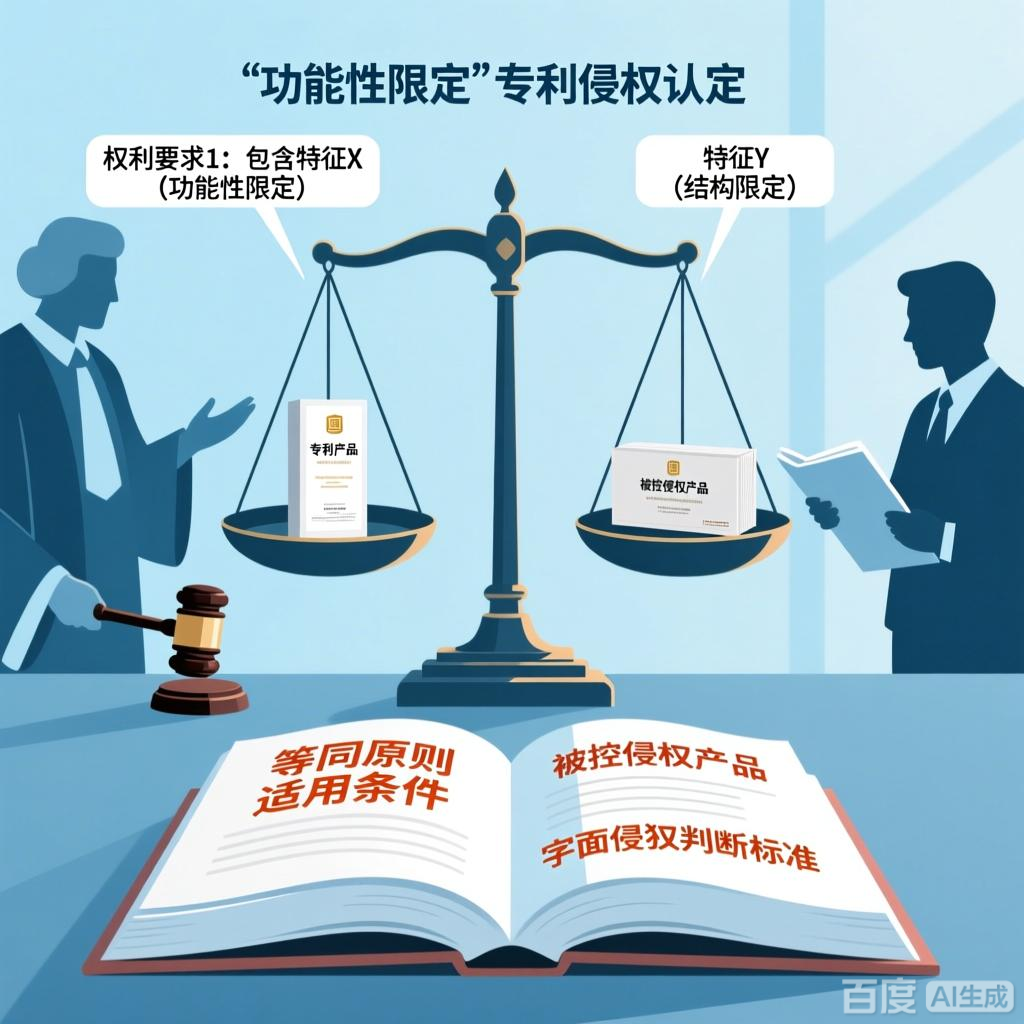
“Functional limitation” is a highly complex issue in patent law. On the one hand, from a drafting perspective, most people dislike using functional limitations; the *Patent Examination Guidelines* specifically require avoiding the use of functionally limited technical features as much as possible. On the other hand, some technical features cannot be limited by structural features, and for others, functional or effect features are more appropriate than structural features, thus necessitating the use of functional limitations. Furthermore, the applicable standards for functional limitations differ in the procedures for granting, confirming, and enforcing patent rights. This article only discusses the infringement determination related to functional limitations in patent infringement disputes.
01 What is a Functional Limitation?
A functional limitation refers to the method of using functional descriptions rather than structural descriptions to limit technical features in the patent claims. Functional limitations do not use structural or methodological features, but rather functional or effect features to limit the scope of technical features protected by the claims. This method of limitation is usually expressed in patent documents as phrases such as “a device capable of…”, “configured as…”, or “achieved by…”. Functional limitations differ from functional features. A functional limitation is a description, while a functional feature is a technical feature. A functional feature equals a functional limitation plus a component/part/mechanism, etc.
The *Patent Examination Guidelines (2023)*, Part II, Chapter 2, Section 3.2.1, “Based on the Specification,” stipulates that, generally, product claims should avoid using functional or effect features to limit the invention. It also specifies the specific circumstances under which using functional or effect features to limit the invention is permitted. Although the application of functional limitations is cautious in patent drafting, in many cases, using functional limitations in patent claims allows for a more flexible description of the technical solution, resulting in better protection of the technical solution. In practice, functional limitations are quite common in claims.
According to the *Patent Examination Guidelines*, the technical features of functional limitations included in a claim should be understood to cover all implementation methods capable of achieving the stated function. This means that a broad interpretation of functional limitations is adopted at the patent grant and confirmation stages. However, according to the “Interpretation of the Supreme People’s Court on Several Issues Concerning the Application of Law in the Trial of Patent Infringement Disputes,” for technical features described in terms of function or effect in the claims, the people’s court should determine the content of the technical feature by combining the specific implementation methods of the function or effect described in the specification and drawings, as well as their equivalent implementation methods. This means that the interpretation of functional limitations is more specific and strict at the infringement determination stage.
For patent holders, in the examination of patent grant and confirmation, as long as there is evidence disclosing an implementation method that can achieve the stated function, it means that the technical feature has been disclosed, which is detrimental to the patent holder obtaining a stable patent right. In infringement determination, however, merely the implementation method that can achieve the stated function is insufficient; it is usually necessary to refer to the content of the specific embodiments of the patent in question. The following uses specific cases as examples to analyze the identification and interpretation of functional limitations in judicial practice.
02 Identification of Functional Limitations
Although functional limitations are described using functional features or effect features, not everything described in the claims is a functional limitation. For example, in the dispute between Dai Moumou and a sporting goods company regarding infringement of a utility model patent, the claims included “closing device.” “Closing” is obviously a function, so the plaintiff, Dai, believed that “closing device” was a functional limitation. The Supreme People’s Court held that although claim 17 of the patent in question limited the function of “closing device” in the patent, the specification and drawings of the patent in question clearly described and marked “closing device”. A person skilled in the art could directly and clearly determine the specific implementation of “closing device” by reading the claims, specification and drawings. Therefore, “closing device” is not a functional feature [1]. In other words, “closing device” is a specific structure or component, not a functional feature. In the patent infringement disputes involving cotton harvester parts company, plastic industry company and others, the Supreme People’s Court clarified the criteria for judging functional features: First, the invention contains technical features that are limited only by function or effect, and the structure, components, etc. corresponding to the technical features are not limited in the invention; second, a person skilled in the art cannot clearly determine the implementation of the technical feature after reading the patent text, that is, cannot clearly determine the structure, components, etc. of the technical feature. In this case, claim 1 of the patent in question defines the structure of the “Z-shaped locking part” and defines the positional relationship and bonding method of the two parts. By reading the definitions in the claims, a person skilled in the art can clearly know the specific structure of the “Z-shaped locking part”. Therefore, the “Z-shaped locking part” is not a functional feature [2].
A special case is the determination of the content of the functional feature when there are multiple usage environments. In the case of a dispute between a certain environmental equipment company and a certain chimney company for infringement of invention patent rights, the Supreme People’s Court clarified that when the patent technical solution recorded in the specification exists in multiple usage environments, the patentee usually does not need to list and describe the specific implementation methods in each usage environment. When the specification only gives an embodiment in one usage environment but clearly records that the technical solution can be applied to multiple usage environments, the implementation methods in other usage environments that a person skilled in the art can directly and clearly obtain by reading the patent claims and based on the known embodiments should belong to the content of the functionally defined technical feature. In this case, it was clarified that the functionally defined technical features in the embodiments can be divided into basic features and adaptive features. Among them, the basic feature is the feature that is essential to achieve the functional effect. It is the essential feature of the functionally defined technical feature and is indispensable in various usage environments. The adaptive feature is the feature that adapts to a specific usage environment due to different usage environments. It is an auxiliary, non-essential, and changeable feature that plays an adaptive and cooperative role in various usage environments. In this case, the adaptive feature was considered to be a feature that describes the usage environment and was not considered to be a distinguishing technical feature [3].
03 Interpretation of Functional Limitations
In patent infringement disputes, whether the accused product and method fall within the scope of protection of the claims is often the focus of the dispute. At this time, determining the scope of protection of the claims is the basis for comparison. When it comes to functional features, how to interpret the functional features and determine their scope of protection is the key to judging whether there is infringement.
The construction of the patent protection system is essentially about exchanging patent disclosure for protection and making a reasonable balance between the interests of the patentee and the public. Therefore, it is not possible to fully consider the interests of the patentee. It is also necessary to avoid obtaining benefits beyond the scope of patent disclosure by using functional features and harming the interests of the public. At the same time, it is necessary to encourage the patentee to fully disclose the patented technology. Based on the need for balancing the above interests, a broad interpretation of functional limitations has not been adopted in the field of infringement determination. Article 4 of the “Interpretation of the Supreme People’s Court on Several Issues Concerning the Application of Law in the Trial of Patent Infringement Disputes” stipulates: “For technical features described in terms of function or effect in the claims, the people’s court shall determine the content of the technical feature in conjunction with the specific implementation methods of the function or effect described in the specification and drawings, and their equivalent implementation methods.” This judicial interpretation, by interpreting functional features as the implementation methods and equivalent implementation methods of the function or effect described in the specification and drawings, stipulates that the content of the technical feature should be determined in conjunction with the specific implementation methods of the function or effect described in the specification and drawings, and all technical features of various specific implementation methods should be considered separately and in parallel as the content of the functional technical feature.
In the case of Bafang Electric Co., Ltd. v. Biwo Technology Co., Ltd. concerning infringement of invention patent rights, the court held that interpreting “connecting mechanism” solely according to its literal meaning as all structures capable of achieving the function of “coaxially connecting the auxiliary gear and the sprocket” would place all connecting mechanisms with this function within the scope of protection of the patent claims. This would unduly expand the scope of protection of the patent rights in question, thereby harming the interests of the public. In this case, the specific implementation of the “connecting mechanism” listed in the specification and drawings of the patent in question is as follows: “The sprocket and the auxiliary gear are connected by a pin, bolt, or foot integrally formed on the auxiliary gear, and an elastic structure is provided in the engagement area of the sprocket and the pin.” “The sprocket is mounted on the drive shaft through a one-way clutch, and the auxiliary gear and the sprocket are rotatably mounted on a common base independently via bearings.” The court determined the scope of protection of the claims based on the specific implementation of the above embodiments as the interpretation of the functional feature. Ultimately, it was determined that the connecting mechanism of the accused product was different from that of the patent in question, and the accused product did not constitute infringement [4].
In the patent infringement dispute between a certain company of Es and a certain company of Shandong, the Supreme People’s Court also made a similar determination. In this case, the plaintiff argued that the “rope differential” is a functional technical feature, and its specific implementation and technical structure can be many different. As long as the structure realizes the function, it can correspond to the feature. The Supreme People’s Court held that interpreting the rope differential as covering any way of realizing the function would lead to the patent in question obtaining an obviously unreasonable broad scope of protection, and should not be adopted. The Supreme People’s Court used the structure in the embodiment to explain the functional technical feature and held that the plaintiff had not proven that the defendant had used the structure [5].
04 Summary
Legal issues related to functional limitations and functional features are relatively complex legal issues in the field of patent law. At the same time, functional limitations and functional features have wide applications in patent claims. In patent infringement cases, for technical features related to functional limitations, it is first necessary to determine whether they are functional technical features, and then determine the scope of protection of the claims in conjunction with the embodiments. The determination of the functional technical features and the scope of protection of the claims often determine the final outcome of the case.
References:
[1] Supreme People’s Court, Civil Judgment No. 2409 of 2022.
[2] Supreme People’s Court, Civil Judgment No. 1472 of 2022.
[3] Supreme People’s Court, Civil Judgment No. 409 of 2019. [4] Tianjin Third Intermediate People’s Court, Civil Judgment No. (2020) Jin 03 Zhi Min Chu 310.
[5] Supreme People’s Court, Civil Judgment No. (2023) Zui Gao Fa Zhi Min Zhong 719.