
Yu Chunbo
The Chinese version was first published on iplead, Date: November 19, 2024
Machine Translated by Google
In practice, the allocation of the burden of proof is often the key to determining the outcome of a case.
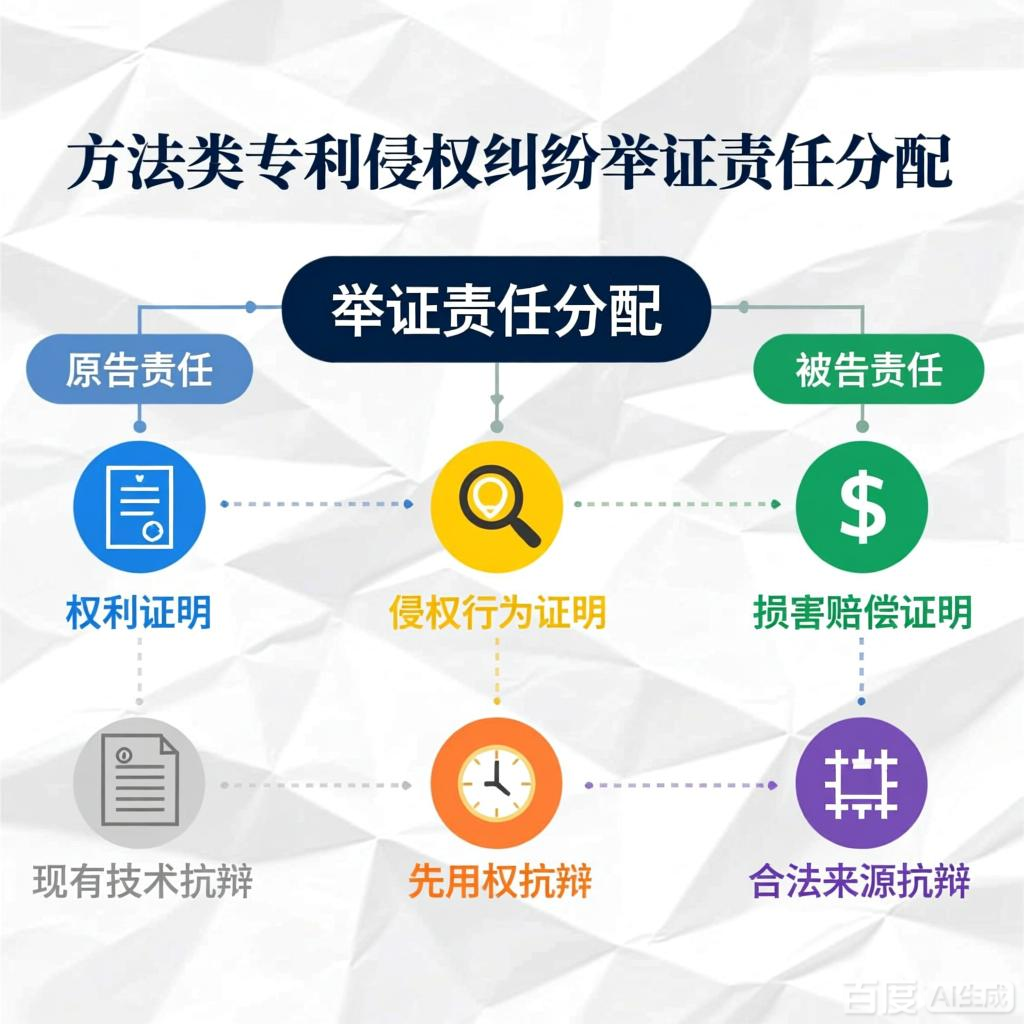
In patent infringement disputes, plaintiffs often face the challenge of providing sufficient evidence. For invention and utility model patents protecting products, methods such as notarized purchase and on-site inspection can allow for a direct comparison of the product’s shape, structure, and connections, resulting in a high-quality technical feature comparison table. However, for patents protecting methods, it is necessary to compare the methods, steps, conditions, and specific parameters, making the burden of proof significantly greater. Therefore, in practice, the allocation of the burden of proof is often crucial in determining the outcome of a case.
I. Allocation of the Burden of Proof
Article 69 of the *Interpretation of the Supreme People’s Court on the Application of the Civil Procedure Law of the People’s Republic of China* stipulates:
“A party shall provide evidence to prove the facts upon which its claims or defenses are based, unless otherwise provided by law. If a party fails to provide evidence or the evidence is insufficient to prove its factual assertions before a judgment is rendered, the party bearing the burden of proof shall bear the adverse consequences.”
Article 2 of the *Provisions of the Supreme People’s Court on Several Issues Concerning Evidence in Intellectual Property Civil Litigation* stipulates:
“A party shall provide evidence to prove its claims. Depending on the circumstances of the case, the people’s court may apply the provisions of Article 65, Paragraph 2 of the Civil Procedure Law, requiring the parties to provide relevant evidence based on their claims, the facts to be proven, their possession of evidence, and their ability to provide evidence.”
These legal provisions illustrate at least three key points: First, the plaintiff bears the burden of proof for the facts upon which its claims are based. Second, the defendant also bears the burden of proof for the facts upon which its defenses are based. Third, the people’s court has discretion in requiring parties to provide evidence and has a certain degree of discretion in assigning the burden of proof. In practice, the plaintiff can at least bear the initial burden of proof, otherwise it may affect the filing of the case, while the defendant often suffers adverse consequences due to its failure to bear the burden of proof.
In the case of “Driver with high output in fault mode”, the plaintiff Siemens presented evidence based on the promotional materials of the defendant Huichuan Company, and the court held that it had fulfilled its initial burden of proof. The defendant Huichuan Company argued that the plaintiff Siemens failed to prove what specific technical means the accused infringing product actually used, and should bear the legal consequences of failing to provide evidence. The defendant Huichuan Company only made relevant defenses, but did not provide evidence of the actual situation of the accused product. The court of first instance held that the defendant Huichuan Company defended against the plaintiff’s claims, arguing that the plaintiff’s evidence could not prove the actual situation of the accused infringing product itself. However, as the provider of the accused infringing product, it failed to provide evidence to refute the plaintiff Siemens’ claims, which constituted a passive defense. The court of first instance supported the plaintiff Siemens’ claims and ruled that the infringement was established. In the second instance, the Supreme People’s Court upheld the judgment of the first instance [1]. This case is a typical example of a defendant neglecting their burden of proof. In practice, many defendants lose their cases due to similar passive defenses. Some defendants, after losing in the first instance, realized their mistake and actively presented evidence in the second instance, achieving a reversal of the verdict. Others, for various reasons, still failed to provide evidence of non-infringement and ultimately bore the liability for infringement. In patent infringement disputes, especially those involving method patents, defendants should actively respond and not easily “lie down.” If the defendant actively assumes the corresponding burden of proof, the plaintiff may bear the legal consequences of failing to provide evidence.
II. Legal Consequences of Failing to Provide Evidence
Based on the fundamental principle of “whoever asserts, must prove,” the plaintiff, as the party asserting the claim, bears the burden of proof. Even if the defendant submits evidence refuting the plaintiff’s claims, if the plaintiff still cannot prove the establishment of infringement, they may bear the legal consequences of failing to provide evidence.
In the case of “A Method for Preventing IP Address Spoofing in Dynamic Address Allocation,” the plaintiff, Huawei, purchased the accused product through a notarized process and commissioned the Telecommunication Technology Labs (TTL) to obtain test results according to Huawei’s testing plan. The test results proved that the method implemented by the accused product was consistent with the patent in question, and the defendant ZTE confirmed the test results. After the incident, the defendant ZTE also commissioned the Telecommunication Technology Labs (TTL) to conduct tests according to ZTE’s test plan. The test results proved that the method implemented by the accused product was inconsistent with the patent in question, and the plaintiff Huawei confirmed the test results. In other words, the plaintiff Huawei fulfilled its initial burden of proof and proved the possibility of infringement. The defendant ZTE also provided evidence to prove that the working mode of the accused product was not unique and did not necessarily constitute infringement.
After investigation, the court of first instance held that there was no evidence to prove the existence of infringement under the normal working mode of the accused product. In the case where the existing evidence could not prove that the defendant ZTE used the method of the patent in question, Huawei, which bore the burden of proof, should bear the legal consequences of failing to provide evidence. The court of second instance upheld the judgment of the first instance [2].
However, if the burden of proof is reversed, the defendant bears the burden of proof. If the defendant cannot provide evidence to prove that there is no infringement, the defendant may also bear the legal consequences of failing to provide evidence. A typical example of the reversed burden of proof is an invention patent involving a method of manufacturing a new product. The accused infringer, who manufactures the same product, bears the burden of proof.
III. Invention Patents Involving Methods of Manufacturing New Products
Article 66, Paragraph 1 of the Patent Law stipulates:
“Where a patent infringement dispute involves an invention patent for a method of manufacturing a new product, the entity or individual manufacturing the same product shall provide proof that its product manufacturing method differs from the patented method.”
This legal provision can be interpreted as follows: In infringement disputes involving invention patents for methods of manufacturing new products, the plaintiff needs to prove two points: first, the dispute involves a “new product”; second, it involves the manufacture of “the same product.” Once the plaintiff proves these two points, the burden of proof is reversed, and the defendant bears the burden of proving that its manufacturing method is different.
In the “Levoamlodipine” case, both the first and second instance courts held that the accused infringer should bear the burden of proving that its manufacturing method was different. Since the accused infringer failed to provide such proof, both the first and second instance courts ruled that infringement was established. In the retrial, the Supreme People’s Court held that, prior to the application date of the patent in question, the intermediate products involved in the accused product were not known to the public at home and abroad, and it could be determined that the product directly obtained according to the method of the patent in question was a new product, and the patent in question belonged to the patent for the manufacturing method of a new product. However, for the accused infringers Zhongqi Company, Huasheng Company, and Ouyi Company to bear the burden of proof that their product manufacturing method was different from the patent method, the right holder Zhang Moumou also needed to prove that the product manufactured by the accused infringers was the same product as the product directly obtained according to the patent method. The evidence provided by Zhang Moumou was insufficient to prove that the product manufactured by Huasheng Company and Ouyi Company was the same product as the product directly obtained according to the method of the patent in question, and the accused infringers Huasheng Company and Ouyi Company should not bear the burden of proof that their product manufacturing method was different from the patent method in this case. Based on the evidence of the whole case, the Supreme People’s Court determined that the infringement claim lacked factual basis, and the retrial revoked the first and second instance judgments and dismissed the plaintiff’s claim[3]. In the case of “Assembled Connecting Channel Structure and its Construction Method”, the plaintiff in the first instance, Ningbo Mou Technology Company, believed that, according to the above-mentioned legal provisions, the burden of proof was reversed in this case. The court of first instance held that the prerequisite for applying the reversal of the burden of proof was that Ningbo Technology Company needed to submit evidence to prove that the patented product in question was a new product. During the trial, the plaintiff, Ningbo Technology Company, failed to provide sufficient evidence to prove that the patented product in question was a new product, and Ningbo Technology Company should bear the consequences of failing to provide evidence. In the second instance, the Supreme People’s Court further found that the communication channel itself was not a new product, and the other evidence presented by Ningbo Technology Company was insufficient to prove that the modular communication channel structure involved in the patent in question was a new product. Therefore, the Supreme People’s Court upheld the judgment of the first instance [4].
As can be seen from the above cases, in infringement disputes involving invention patents for new product manufacturing methods, the allocation of the burden of proof is often the key to winning or losing the case. The key is that the plaintiff needs to prove that the accused product is a new product and that the product is the same as the product directly obtained by the method patent. If the plaintiff can prove the above two points, then according to the explicit provisions of the Patent Law, the reversal of the burden of proof occurs, and the defendant needs to prove his innocence, otherwise he will bear the adverse consequences of failing to provide evidence. If the plaintiff cannot prove the above two points, the burden of proof cannot be reversed, and the plaintiff still bears the burden of proving the existence of the infringement. If the plaintiff’s evidence fails to meet the standard of proof, the plaintiff will bear the adverse consequences of failing to provide evidence.
IV. Conclusion
As is well known, “litigation is about evidence.” In patent infringement disputes, evidence used to prove the existence of infringement is particularly crucial. Before presenting evidence, both the prosecution and the defense should pay attention to the allocation of the burden of proof. In method patent infringement cases, the patent in question protects the method, and the implementation of the method is often time-limited. When both parties have certain deficiencies in providing evidence, the allocation of the burden of proof is the key to determining the outcome of the case. The party bearing the burden of proof may suffer adverse legal consequences due to insufficient evidence.
References
[1] Supreme People’s Court, (2020) Supreme Court Intellectual Property Civil Judgment No. 1593.
[2] Zhejiang Provincial Higher People’s Court, (2014) Zhejiang Intellectual Property Civil Judgment No. 161. [3] Supreme People’s Court, Civil Judgment No. 84 of 2009.
[4] Supreme People’s Court, Civil Judgment No. 1660 of 2022.