
Yu Chunbo
The Chinese version was first published on iplead, Date: October 8, 2024
Machine Translated by Google
If the granting of a patent right does not comply with the provisions of the Patent Law, then the patent right has not made a compliant contribution. In this case, its exclusive right violates the principle of fairness and is an unreasonable restriction and infringement on the legitimate rights and interests of society and the public.
In patent infringement litigation, even if the technology implemented by the accused infringer falls within the scope of protection of the patent claims in question, it does not necessarily lead to the establishment of infringement and the occurrence of infringement liability. A common situation is that, after feature comparison, the technology implemented by the accused infringer originates from technology that was already known to the public before the patent application date in question. Patent rights are the exclusive rights enjoyed by the right holder over inventions and creations, and have exclusivity and exclusivity. Their rights come from the patent holder’s compliant contribution to society. As a reward for the contribution, the patent holder enjoys corresponding rights in accordance with the law. If the grant of a patent right does not comply with the provisions of the patent law, the patent right has not made a compliant contribution. At this time, its exclusive right violates the principle of fairness and is an unreasonable restriction and infringement on the rights and interests that society and the public should have [1]. Therefore, the aforementioned situation is essentially that the patent itself has defects, and the corresponding accused infringing act should not constitute infringement.
I. Overview of Prior Art Defense
The prior art defense system originated in Germany. As early as 1891, the German Patent Law set a five-year limitation period for invalidation requests. According to this provision, after the limitation period has expired, others cannot apply for invalidation of the patent. At this time, if the patent has defects, such as applying for a patent for prior art, it is very unfair to the implementer of the prior art and should be remedied [2]. Other countries that implement patent systems, such as the United States and Japan, also have corresponding institutional designs. The purpose of this system is to enable the implementer of prior art to obtain timely relief through the simplest procedure when the patent confirmation and patent infringement adjudication institutions are separated. Its nature is a right of defense. In the third revision of the Patent Law in 2008, my country clarified the definition of prior art and prior design in Article 22, Paragraph 5 and Article 23, Paragraph 4 of the Patent Law, and stipulated in Article 62 (Article 67 of the current Patent Law): In patent infringement disputes, if the accused infringer has evidence to prove that the technology or design implemented by him belongs to prior art or prior design, it does not constitute patent infringement. Therefore, the implementer of the prior art who is accused of infringement can assert the prior art defense. Although prior art defense was only legalized in the 2008 revision of the Patent Law, it had already appeared multiple times in my country’s judicial practice as a remedy before 2008. It is often referred to as “publicly known technology defense,” for example, in the patent infringement dispute between plaintiff Xin and defendants Shanghai Wanda Electronics Co., Ltd., Shanghai Sikelu Electronic Technology Co., Ltd., Shanghai Chuansha Color Printing Advertising Factory, and Hainan Baima Advertising Media Investment Co., Ltd. [3], and in the patent infringement appeal case between Beijing Nanchen Investment Co., Ltd., Beijing Weihou Aluminum Co., Ltd., and Shanghai Huayuan Aluminum Co., Ltd. [4]. It can also be referred to as “existing technology defense,” for example, in the patent infringement dispute between Kohler and B. Braun (Shanghai) Sanitary Ware Equipment Co., Ltd., B. Braun (Guangzhou) Sanitary Ware Equipment Co., Ltd., and Beijing Xingping Weiye Technology Co., Ltd. [5].
When an implementer of prior art wishes to obtain relief through prior art defense, they only need to submit evidence asserting prior art defense and an explanation of the reasons based on the evidence within the time limit allowed by the court to assert that no infringement has occurred. However, in practice, the legality, authenticity, and relevance of prior art defense evidence are often controversial, especially the difficulty in proving the publication time of prior art defense evidence. Furthermore, whether the technical features claimed by the patent in question, the technical features of the accused infringing product, and the technical features of the prior art evidence are identical or equivalent can also be highly controversial. Therefore, in practice, the difficulty of proving prior art defenses often exceeds the expectations of the prior art implementer.
II. Objects of Technical Feature Comparison and Evidence Standards
Article 14, Paragraph 1 of the Interpretation of the Supreme People’s Court on Several Issues Concerning the Application of Law in the Trial of Patent Infringement Disputes (Fa Shi [2009] No. 21) stipulates:
If all the technical features of the accused infringing product that fall within the scope of patent protection are identical or have no substantial difference from the corresponding technical features in a prior art solution, the people’s court shall determine that the technology implemented by the accused infringer belongs to the prior art as stipulated in Article 62 of the Patent Law.
Therefore, the objects of technical feature comparison are the technical features of the accused infringing product and the prior art solution, but the technical features of concern are those within the scope of protection of the claims. In practice, various comparative methods have been employed to assert prior art defenses. For example, one method involves simultaneously comparing the claims of the patent in question, the accused infringing product, and prior art evidence, commonly known as a “three-way comparison.” This comprehensively analyzes whether the accused infringing product, within the scope of the claims, constitutes prior art, or is closer to prior art than the patent in question. Another method compares the accused infringing product with prior art evidence, commonly known as a “two-way comparison.” In this case, only the analysis of whether the accused infringing product constitutes prior art is performed. Although presented in a “two-way comparison” format, the comparison should still be conducted within the scope of the claims.
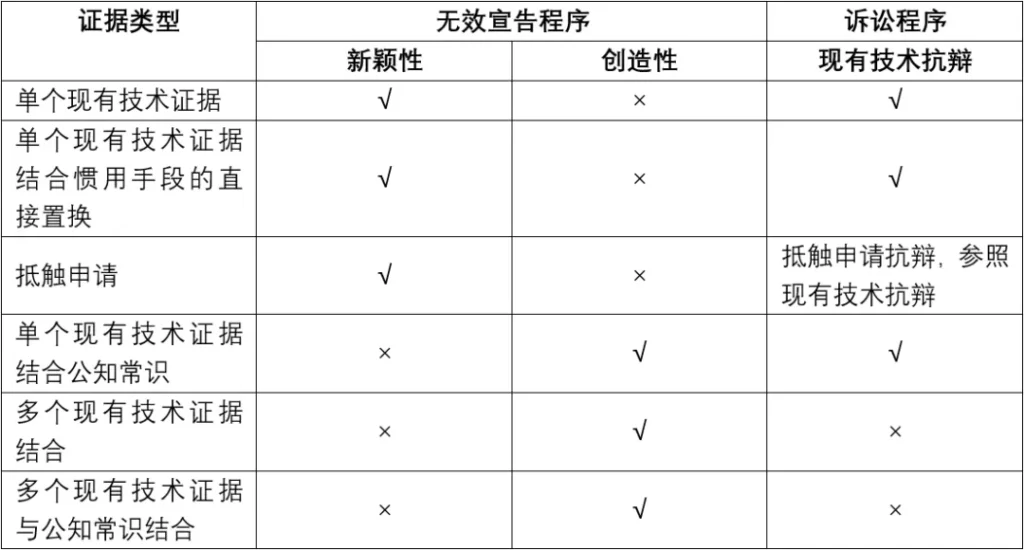
It is important to note that, in addition to prior art evidence, conflicting applications can also be asserted as a defense in infringement litigation. The guiding opinions on patent adjudication issued by the Beijing Higher People’s Court and the Shanghai Higher People’s Court both state that conflicting application defenses can refer to prior art defenses. In cases lacking inventive step, an assertion can be based on a single piece of prior art evidence combined with common sense, or on a combination of prior art evidence or a combination of prior art combined with common knowledge.
There is no clear standard of evidence for establishing a prior art defense, and various viewpoints have emerged in the theoretical community, making it a highly controversial issue. For example:
Viewpoint 1: Evidence for a prior art defense should prove that the claims lack novelty. This viewpoint argues that, to avoid differences in evidentiary standards between different courts leading to inconsistent judgments in similar cases, the novelty standard should be used for prior art defenses in my country [6].
Viewpoint 2: Determine whether the accused infringing technology is substantially equivalent to or different from the prior art. If it is not substantially different, but rather a simple combination of related prior art, or a technology formed by combining prior art with professional technical knowledge acquired by a person skilled in the art without inventive effort, then the accused infringing technology is equivalent to the prior art, and the prior art defense is established [7]. This viewpoint is actually similar to the inventiveness standard, that is, if the accused infringing technology is the same as the prior art or belongs to a technology that lacks inventiveness compared to the prior art, then the prior art defense is considered established [8]. Viewpoint 3: The standard should be that the accused infringing technology lacks novelty or obvious inventiveness compared to the prior art, and the evidence should be limited to one prior art, combined with common technical knowledge known to those in the relevant technical field [9].
Currently, in practice, the evidentiary standard for prior art defense mainly adopts the above-mentioned viewpoint 3, that is, if the accused infringing technology is the same as the prior art or the prior art combined with common technical knowledge, then the prior art defense is considered valid. Article 137 of the Beijing High People’s Court’s Guidelines for Patent Infringement Determination (2017) stipulates:
Prior art defense refers to the situation where all the technical features of the accused technology falling within the scope of patent protection are the same or equivalent to the corresponding technical features in a prior art solution, or if a person skilled in the art believes that the accused infringing technical solution is a simple combination of prior art and common technical knowledge in the relevant field, then the technology implemented by the accused infringer should be considered prior art, and the accused infringer’s actions do not constitute patent infringement. Image
In the civil judgment of the second instance of the dispute over infringement of utility model patent rights between Shenzhen Youxing New Energy Co., Ltd., Apple (Hangzhou) Optoelectronic Glass Technology Co., Ltd., etc., the Supreme People’s Court held that, compared with the corresponding technical features of the prior art evidence, the technical features that distinguish the accused infringing product from all the technical features that fall within the scope of protection of claim 6 of the patent in question are well-known and commonly used technical means and belong to common knowledge in the field. The technical solution of the accused infringing product that falls within the scope of protection of claim 6 of the patent in question has no substantial difference from the corresponding technical solution of the prior art evidence and the simple combination of common knowledge. Therefore, the technology implemented by the accused infringing product belongs to the prior art, and the prior art defense is established[10]. In the case of the dispute over infringement of utility model patent rights between Zhongshan Jiayou Lighting Electric Appliance Co., Ltd., Zhongshan Zhongwo Optoelectronic Technology Co., Ltd., etc.[11] and the case of the dispute over infringement of invention patent rights between Foshan Jimi Intelligent Technology Co., Ltd., Guangzhou Aimeiyou Technology Co., Ltd., etc.[12], the Supreme People’s Court also determined that the prior art defense was established based on the prior art evidence combined with the content disclosed by common knowledge.
Regarding the second viewpoint, there have been no cases in recent years that compare the accused infringing technology with the prior art evidence. In the case of Chen Xuntao v. Shenzhen Boda Shenxin Technology Co., Ltd. regarding infringement of utility model patent rights, the Supreme People’s Court held that prior art comparison in infringement defenses differs from the assessment of patent inventiveness. It is not necessary to judge whether the difference between the accused infringing technical solution and the prior art solution is something a person skilled in the art would easily conceive of, or whether there is any technical inspiration; it is only necessary to judge whether the difference constitutes a substantial difference in terms of the technical solution. Therefore, the view that prior art defense evidence should adopt the inventiveness standard has not been adopted by the courts. Cases using prior art combined with common general knowledge are based on the premise that the distinguishing features are common general knowledge, and therefore the difference between the accused infringing technology and the prior art does not constitute a substantial difference.
In summary, the combination of evidence in prior art defenses differs from the combination of novelty and inventiveness evidence in invalidation proceedings, as roughly shown in the table below.
III. Determination of Public Use Evidence
Public use is a form of prior art disclosure, originating from the *Patent Examination Guidelines*. The *Patent Examination Guidelines* stipulate that any disclosure of a technical solution due to use, or that renders the technical solution publicly known, constitutes public use. Public use includes methods such as manufacturing, using, selling, importing, exchanging, gifting, demonstrating, exhibiting, and bidding, all of which enable the public to know the technical content. As long as the relevant technical content is made publicly known through these methods, it constitutes public use, regardless of whether the public actually knows it.
In practice, a common form of public use is when patent-related products have been sold or exhibited before the patent application date. Prior art defense is a common defense in patent infringement disputes. In such disputes, the plaintiff and defendant are often competitors and familiar with each other’s products. Therefore, the defendant often asserts a prior art defense based on the plaintiff’s prior sales or exhibitions. However, in practice, establishing a prior art defense is difficult. The main reason is the significant challenge in forming a complete chain of evidence regarding the disclosure time and content of prior art through public use. For example, in the case of Changshu Bailian Automatic Machinery Co., Ltd. v. Suzhou Biyangte Garment Equipment Co., Ltd. concerning a dispute over infringement of a utility model patent, the defendant argued for prior art defense, and the court of first instance held that the prior art defense was valid. However, in the second instance, the court of second instance held that the product in question could be replaced after the sale, and that the mounting holes of the product on the machine showed signs of being artificially enlarged. Therefore, without conclusive evidence, the court could not determine whether the product inspected on-site by the court of first instance had been replaced after the sale. The court of second instance overturned the judgment of the first instance, finding that the prior art defense was invalid [13].
Besides the situation where it is impossible to determine whether parts have been replaced, there are many other key points and difficulties in presenting evidence. For example: Was there a contract and invoice at the time of sale? Did the product model indicate on the contract and invoice? Was the actual delivery time before the application date? Was the nameplate replaced? Was the equipment in a situation where it was known to the public after the sale, or was the sale for trial production purposes and confidentiality measures were taken? Did the use of publicly available evidence maintain the true condition of the product at the time of manufacture? If modifications were made, what were those modifications? These questions will all affect the validity of the prior art defense.
[Image] IV. Summary and Outlook
The patent in question protects prior art prior to the application date, which is a case of patent grant error. If the defendant in an infringement lawsuit discovers this situation, in addition to filing a patent invalidation request with the State Intellectual Property Office to correct the grant error, they can, according to the Patent Law, assert a prior art defense in the litigation. As for the plaintiff, they should carefully verify the evidence for the prior art defense. If the evidence is indeed flawed or does not meet the standard of proof, they should actively respond to it to avoid failing to obtain effective protection despite having legitimate rights.
References
[1] State Intellectual Property Office. Introduction to Patent Agency [M]. Beijing: Intellectual Property Publishing House, 2002. 375.
[2] Li Xiaohuan. A Review of the Prior Art Defense System [J]. Consumer Guide, 2018(2): 133-134.
[3] Shanghai No. 1 Intermediate People’s Court, Civil Judgment No. 273 of 2005 (Shanghai No. 1 Intermediate People’s Court).
[4] Shanghai Higher People’s Court, Civil Judgment No. 4 of 2004 (Shanghai Higher People’s Court).
[5] Beijing No. 2 Intermediate People’s Court, Civil Judgment No. 13842 of 2008 (Beijing No. 2 Intermediate People’s Court). [6] Zhang Peng, Cui Guozhen. An Exploration of Comparison Methods and Standards for Prior Art Defense [J]. Intellectual Property, 2009(1):66.
[7] Tan Xiaoqing. Application of the Prior Art Defense Principle in Patent Infringement Litigation [J]. People’s Justice, 2002(8):22.
[8] Yan Wenjun. Scope of Patent Protection [M]. Legal Publishing House, 2007.
[9] Zhang Xiaodu. Identification of Prior Art Defense [M]. Liu Hua. Selected Intellectual Property Cases. Beijing: Intellectual Property Publishing House, 2008:106.
[10] Supreme People’s Court, Civil Judgment No. 1601 of 2021.
[11] Supreme People’s Court, Civil Judgment No. 266 of 2021.
[12] Supreme People’s Court, Civil Judgment No. 815 of 2021. [13] Jiangsu Provincial Higher People’s Court, (2016) Su Min Zhong No. 1353.