
Yu Chunbo
The Chinese version was first published on iprdaily.cn, Date: August 27, 2024
Machine Translated by Google
“This article provides a brief analysis of the illegal sale of counterfeit seeds, the possible crimes involved, and the corresponding penalties.”
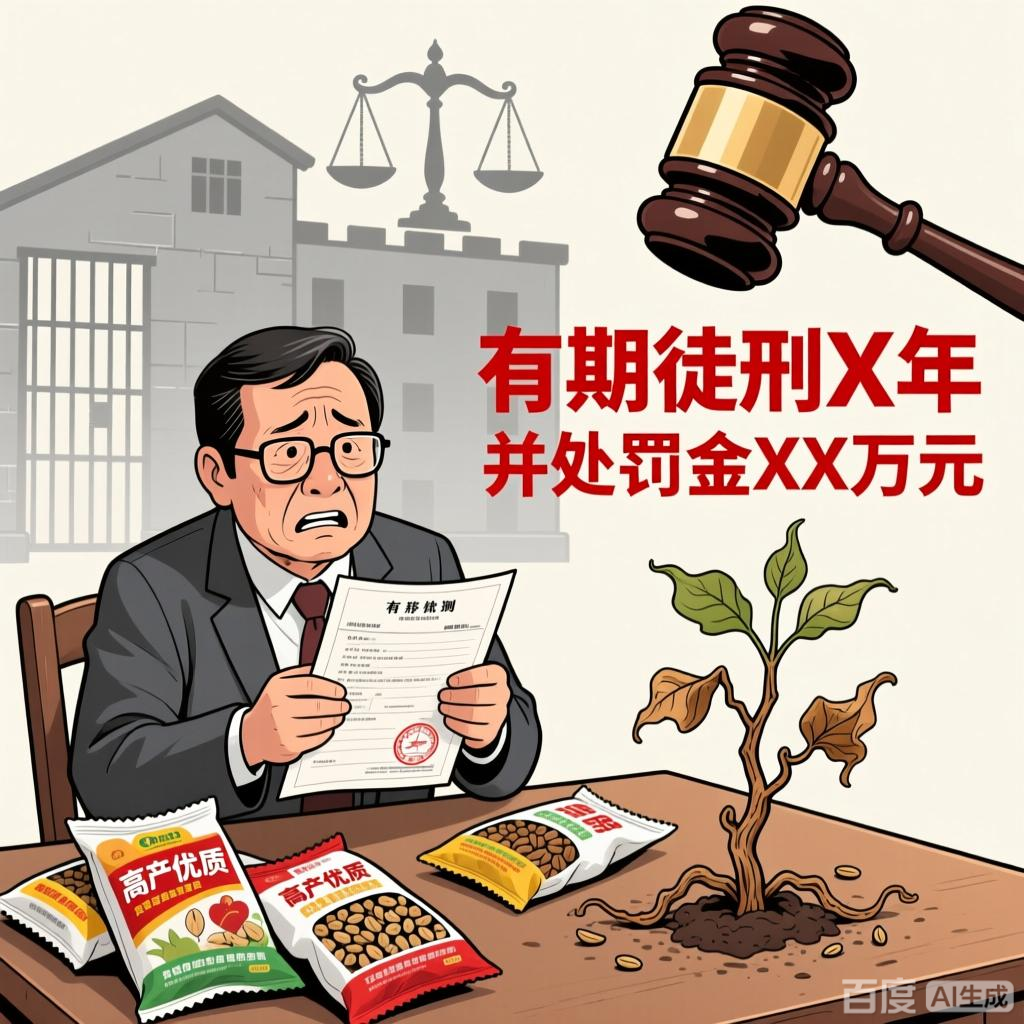
On May 8, 2024, Southern Weekly published a report titled “Rampant Counterfeit Seeds: Repackaging, Theft, and Crackdown,” revealing that counterfeit corn seeds remained rampant in the major corn-producing areas of Northeast China—many counterfeit seeds lacking approval numbers and being sold openly in repackaged forms. Following the report, it attracted widespread attention from all sectors of society. The Ministry of Agriculture and Rural Affairs instructed Jilin Province to quickly organize an investigation and dispatched a working group to Changchun City and other areas in Jilin Province to investigate and verify the facts. As of July 4, 2024, the Jilin Provincial Public Security Department had filed 15 criminal cases against the illegal sale of counterfeit seeds. The Jilin Provincial Department of Agriculture and Rural Affairs had revoked the crop seed production and operation licenses of 11 related production enterprises.
With the development of science and technology and the progress of society, the hunger of famine years seems to be a distant memory. Few people remember that large-scale famines have only been gone for a little over 60 years. Spring blossoms and autumn harvests—the growth of grain crops requires a complete growing season. Farmers who purchase and plant counterfeit seeds often don’t immediately discover the problems; the harm only becomes apparent after harvest, by which time the damage has already occurred. As a populous nation, my country’s food security is of paramount importance, and the crackdown on counterfeit seeds must be continuous and maintain a strong deterrent effect.
The illegal trade in counterfeit seeds, including the production and sale of fake seeds and the infringement of intellectual property rights through trademark infringement, seriously endangers national food security and has significant social harm. Therefore, my country’s Criminal Law stipulates a series of crimes related to these activities. This article briefly analyzes the possible crimes and corresponding penalties for the illegal trade in counterfeit seeds.
PART 01
Overview of Conflicting Legal Provisions
Article 147 of the Criminal Law stipulates: Anyone who produces counterfeit pesticides, veterinary drugs, or fertilizers; sells pesticides, veterinary drugs, fertilizers, or seeds knowing they are counterfeit or have lost their effectiveness; or whose producers or sellers pass off substandard pesticides, veterinary drugs, fertilizers, or seeds as qualified ones, causing significant losses to production, shall be sentenced to fixed-term imprisonment of not more than three years or criminal detention, and shall also be fined not less than 50% and not more than 200% of the sales amount; if the losses to production are serious, the sentence shall be fixed-term imprisonment of not less than three years and not more than seven years, and a fine of not less than 50% and not more than 200% of the sales amount shall also be imposed; if the losses to production are particularly serious, the sentence shall be fixed-term imprisonment of not less than seven years or life imprisonment, and a fine of not less than 50% and not more than 200% of the sales amount or confiscation of property shall also be imposed.
Regarding the illegal operation of counterfeit seeds, the crime corresponding to the above article is the crime of producing and selling counterfeit and substandard seeds. Apart from this, the Criminal Law does not contain any articles directly mentioning counterfeit seeds. However, in judicial practice, only a small portion of criminal cases involving the illegal sale of counterfeit seeds are convicted and sentenced for the crime of producing and selling counterfeit seeds. Cases related to the illegal sale of counterfeit seeds often involve conflicting legal provisions.
It is generally believed that conflicting legal provisions arises because several laws or articles within the same law describe the same elements of the crime, leading to conflicting provisions. In such cases, only one provision is applied for conviction and sentencing, excluding other provisions [1]. Specifically, in this case, the suspect only committed the act of illegally selling counterfeit seeds, but this act meets the elements of multiple crimes, including the crime of producing and selling counterfeit seeds, the crime of counterfeiting registered trademarks, and the crime of illegal business operations. Since the suspect only committed one act, and the elements of these crimes overlap, in this situation, one of the aforementioned crimes is chosen for conviction and sentencing, excluding the application of other crimes.
When legal provisions conflict, there are usually two types of relationships: inclusion and overlap. In cases involving counterfeit seeds, there is often overlap between parts of two legal provisions. In such cases, the court needs to determine the most prominent characteristic of the overlapping part of the act to identify the specific crime committed.
PART 02
Possible Crimes and Penalties for Producing and Selling Counterfeit Seeds
Illegally dealing in counterfeit seeds may constitute the crime of producing and selling counterfeit seeds. For example, in the second-instance criminal ruling on Zhou Moumou’s crime of producing and selling counterfeit seeds, the defendant Zhou Moumou sold “HR361” sunflower seeds and “Jinguo No. 1” shell-less pumpkin seeds to 45 victims in multiple locations through direct sales or through agents, covering a planting area of 5186 mu. The victims discovered numerous problems during the growth period of the sunflowers and pumpkins. Later, the Fuhai County Agricultural Bureau determined that the “HR361” sunflower seeds and “Jinguo No. 1” shell-less pumpkin seeds sold by the defendant Zhou Deqiang were counterfeit seeds. According to judicial appraisal, the total loss of sunflowers and shell-less pumpkins planted by the 45 households, including the victim Yang, amounted to RMB 4,268,636.86. The court sentenced the defendant Zhou to seven years in prison and fined him RMB 420,000 for the crime of selling counterfeit and substandard seeds; he was also ordered to continue to compensate the 45 victims for their economic losses; and the court confiscated the seeds involved in the case.[2]
Article 147 of the Criminal Law stipulates the constituent elements of the crime of producing and selling counterfeit and substandard seeds, including “causing significant losses to production” or “causing particularly serious losses to production.” Article 7 of the Interpretation of the Supreme People’s Court and the Supreme People’s Procuratorate on Several Issues Concerning the Specific Application of Law in Handling Criminal Cases of Producing and Selling Counterfeit and Inferior Goods (Fa Shi [2001] No. 10) stipulates that in Article 147 of the Criminal Law, the crime of producing and selling counterfeit and inferior pesticides, veterinary drugs, fertilizers, and seeds generally starts at 20,000 yuan for “relatively significant losses to production,” 100,000 yuan for “major losses,” and 500,000 yuan for “particularly serious losses to production.” The aforementioned cases were determined to have “particularly serious losses to production” through judicial appraisal. Other cases present different circumstances.
Regarding the illegal sale of counterfeit seeds in other cases, the filing of cases often occurs during the production and sale of counterfeit seeds. At this time, the counterfeit seeds have only been on the market for a short time; the buyers often haven’t had time to plant them, or the crops haven’t been harvested, or the losses to production cannot be fully accounted for after harvest. During the trial, it is often impossible to determine the losses to production caused by their actions. In response to this situation, the Supreme People’s Court issued the “Guiding Opinions on Further Strengthening Criminal Trial Work Involving Seeds” (Fa [2022] No. 66), which clearly stipulates that: For acts of producing and selling counterfeit or substandard seeds, where the act does not constitute the crime of producing and selling counterfeit or substandard seeds due to reasons such as the inability to determine that production suffered significant losses, but the sales amount exceeds 50,000 yuan, the act shall be convicted and punished as the crime of producing and selling counterfeit or substandard products in accordance with Article 140 of the Criminal Law. If the act also constitutes other crimes such as counterfeiting registered trademarks, the more severe punishment shall apply.
In this case, the crimes involved mainly include the crime of producing and selling counterfeit or substandard products, the crime of counterfeiting registered trademarks, the crime of selling goods bearing counterfeit registered trademarks, and the crime of illegal business operations. The above notice also clarifies that in cases where there is a conflict of laws regarding the above crimes, the more severe punishment shall apply.
For example, the case of Wang Moumou’s crime of counterfeiting registered trademarks. In 2018, the defendant, Wang, provided false trademark authorization documents and other materials, and commissioned others to produce over 40,000 counterfeit “Hongyingzi” brand plastic packaging bags. Between March and May 2019, Wang rented a house and hired workers to produce counterfeit seeds using old sorghum and sorghum purchased from others. The seeds were packaged in “Hongyingzi” brand plastic bags and then sold to multiple individuals, totaling 8,800 jin (approximately 4,400 catties). According to the Ruyang County Price Certification Center, the market price of the “Hongyingzi” brand Red Pearl sorghum seeds was 20 yuan per jin, totaling 176,000 yuan. The case was uncovered in May 2019; the counterfeit sorghum seeds had not yet been planted, so it could not be determined that it “caused significant losses to production.” However, the court held that the “Hongyingzi” trademark was legally registered with the Trademark Office of my country and was within its validity period, thus protected by law. The defendant, Wang, was found guilty of counterfeiting registered trademarks and sentenced to one year and six months in prison and fined RMB 90,000. The counterfeit trademarks seized by the public security organs were confiscated and destroyed in accordance with the law. This case is the second of the ten typical intellectual property cases released by the Luoyang Intermediate People’s Court [3]. PART 03 The possible crimes and penalties for “seed packaging” “Seed packaging” is also known as “seed counterfeiting”, which refers to the act of putting counterfeit packaging on seeds that are not originally qualified for sale and selling them. Specifically, it generally includes the following situations, such as passing off inferior products as superior ones, using unpopular varieties in fake packaging to impersonate approved brand-name varieties with legal market access qualifications. Or using illegally obtained parent lines to breed seeds of brand-name varieties and putting them in fake packaging for sale. It can also extend to the act of replacing or altering the outer packaging of genuine seeds and selling them privately. The act of “seed bundling” is typically an infringement of plant variety rights. Under the current legal system, infringement of plant variety rights is a civil tort and not regulated by the Criminal Law. However, “seed bundling” is often accompanied by other crimes such as counterfeiting registered trademarks and infringing trade secrets. The Supreme People’s Court issued the “Guiding Opinions on Further Strengthening Criminal Trial Work Involving Seeds” (Fa [2022] No. 66), stipulating that “seed bundling” infringement will be considered an aggravating circumstance, strengthening the crackdown on related criminal offenses.
For example, in the case of Li Moumou counterfeiting registered trademarks, the defendant Li Moumou operated the “Honest Seed and Pesticide Supermarket” on Zhengdian Street, Zhengdian Town, Leling City, Dezhou. In January 2019, Li Moumou repackaged 500 bags of old “Denghai No. 9” corn seed bundles into bags of corn seeds he purchased via WeChat, labeled with brands such as “Fengmou 2 Brand Dacheng 168” and “Shiji Haofengshou Brand Liyu 19,” and then provided these bundled corn seeds to Li Mou1 for sale. Subsequently, Li Moumou purchased unbranded “Denghai 605” and “Nongda 372” corn seeds in bulk, repackaged them into bags labeled with brands such as “Denghai Brand Denghai 605” and “Jiuding Jiusheng Brand Nongda 372,” and sold these seeds to Li Mou1 and others. Li Moumou’s actions constitute a typical case of “seed bundling,” as the bundled varieties all bear registered trademarks used on corn seeds, thus constituting the crime of counterfeiting registered trademarks. Considering his voluntary surrender, truthful confession of his crimes (considering self-surrender), proactive return of illicit gains after the incident, and voluntary plea of guilty, the court granted him leniency according to law. Li was sentenced to four months of detention, suspended for eight months, and fined[4].
PART 04
Summary and Outlook
For a considerable period of time in the past, crimes related to counterfeit seeds and infringement of intellectual property rights were rampant. However, the state has continuously strengthened its crackdown on related crimes. In the “Seed Industry Revitalization Action Plan” jointly issued by the General Office of the CPC Central Committee and the General Office of the State Council, it was clearly deployed to implement the seed industry market purification action, proposing to “take a heavy blow, rectify thoroughly, and deter effectively, and severely crack down on illegal and criminal acts such as counterfeiting, counterfeiting, and infringement, so that infringers will pay a heavy price.” It is foreseeable that if criminals continue to have a fluke mentality and commit crimes related to counterfeit seeds, they will be punished according to law.
References:
[1] Zuo Qiyang, Concurrence of Legal Provisions and Determination of Crimes, China Court Network https://www.chinacourt.org/article/detail/2003/08/id/75121.shtml. [2] Altay Intermediate People’s Court, Xinjiang Uygur Autonomous Region, Criminal Ruling No. (2019) Xin 43 Xing Zhong 114.
[3] Luoyang Intermediate People’s Court, Henan Province, Criminal Judgment No. (2019) Yu 03 Xing Chu 50.
[4] Linyi County People’s Court, Criminal Judgment No. (2019) Lu 1424 Xing Chu 254.