
Yu Chunbo
The Chinese version was first published on iprdaily.cn, Date: July 29, 2024
Machine Translated by Google
“This article analyzes the remedies and specific practices for those who disagree with invalidation decisions, using specific cases as examples.”
A patent right is an exclusive property right granted to a patentee by the State Intellectual Property Office in accordance with the relevant provisions of the Patent Law. In modern business warfare, patent rights are both a powerful weapon for patentees and a key target for competitors. The primary method of challenging a patent right is to file a patent invalidation request. The Patent Reexamination and Invalidation Department of the State Intellectual Property Office (formerly the Patent Reexamination Board) will examine the patent invalidation request filed by the requester and issue an invalidation decision.
After an invalidation decision is made, one party will always disagree with it, and sometimes both parties will disagree. In such cases, the parties are most concerned about how to revoke the invalidation decision if it contains errors. This article analyzes the remedies and specific procedures for disagreeing with an invalidation decision, using specific cases as examples.
PART 01
Overview of Patent Invalidation Procedures
Article 45 of the Patent Law stipulates that from the date the State Council’s patent administration department announces the grant of a patent right, any entity or individual who believes that the grant of the patent right does not comply with the relevant provisions of this Law may request the State Council’s patent administration department to declare the patent right invalid. Article 47 stipulates that a patent right declared invalid is deemed to have never existed.
Patent rights are granted to patentees only after examination by the State Intellectual Property Office (SIPO), which deems the patent right to comply with the provisions of the Patent Law. Therefore, according to the aforementioned legal provisions, the patent invalidation procedure is essentially a correction of errors in the patent granting procedure. The patent granting procedure needs to consider the principle of procedural economy and cannot invest unlimited human and material resources to ensure the correctness of every patent right granted. The correctness of the granting of some patent rights is transferred to the subsequent confirmation procedure, i.e., the patent invalidation procedure, for resolution.
Any entity or individual can file an invalidation request against a granted patent. In practice, some actual applicants conceal their true identities and file invalidation requests in the name of other entities or individuals (usually individuals). The nominal applicant is referred to in the industry as a “scarecrow.” In a special case, the patentee can also file an invalidation request against their own patent right, but can only apply for partial invalidation, not complete invalidation.
In invalidation proceedings, the principle of request must be met. This means the panel must review the case based on the evidence and reasons presented by the invalidation requester and generally cannot introduce evidence independently. Therefore, a requester filing an invalidation request cannot simply state a claim hoping the State Intellectual Property Office will independently search for evidence and proactively re-examine the validity of the patent right. Instead, they must provide their own evidence and clearly state the facts and reasons.
PART 02
Remedies for Dissatisfied Patent Invalidation Decisions
Article 46, Paragraph 2 of the Patent Law stipulates that if a party is dissatisfied with the decision of the State Council’s patent administration department to invalidate or uphold a patent right, they may file a lawsuit with the People’s Court within three months from the date of receiving the notification. The People’s Court shall notify the opposing party in the invalidation request proceedings to participate in the litigation as a third party. Typically, the final paragraph of the invalidation decision will explicitly state to both parties: “If a party is dissatisfied with this decision, they may, in accordance with Article 46, Paragraph 2 of the Patent Law, file a lawsuit with the Beijing Intellectual Property Court within three months from the date of receipt of this decision. According to this paragraph, after one party files a lawsuit, the other party participates in the litigation as a third party.”
Based on the above legal provisions, the remedy for dissatisfied with a patent invalidation decision is to file a lawsuit in a People’s Court. The defendant in a patent invalidation decision is the State Intellectual Property Office, and the other party in the invalidation proceedings is a third party. Jurisdiction is determined by the defendant’s jurisdiction; first instance trials in patent invalidation administrative disputes are all under the jurisdiction of the Beijing Intellectual Property Court, while second instance trials are all under the jurisdiction of the Intellectual Property Tribunal of the Supreme People’s Court. Some parties, unaware of the remedy procedure or hoping the State Intellectual Property Office will correct its own error based on its own understanding, may apply for administrative reconsideration to the State Intellectual Property Office. In this case, the State Intellectual Property Office will issue a notice of non-acceptance of the reconsideration application, informing the party of the correct remedy.
The correct remedy is to file an administrative lawsuit. For example, in the case of “Self-generating chemical current linkage press needle”, the State Intellectual Property Office made an examination decision, believing that all claims of the patent lacked inventiveness and declared the patent invalid. The patentee, a medical device company, disagreed and filed a lawsuit with the Beijing Intellectual Property Court. After hearing the case, the Beijing Intellectual Property Court held that claim 1 of the patent had inventiveness and revoked the invalidation decision. The State Intellectual Property Office and the third party participating in the litigation disagreed with the first-instance judgment and appealed to the Supreme People’s Court. The Supreme People’s Court held that the evaluation methods for modern medical technology should not be simply applied, and the degree of innovation of traditional Chinese medicine technology solutions should be underestimated. In the end, the appeal was rejected and the first-instance judgment was upheld [1]. This case was selected into the People’s Court Case Database and has reference value for similar cases. PART 03
Reasons for Revoking Invalidation Decisions
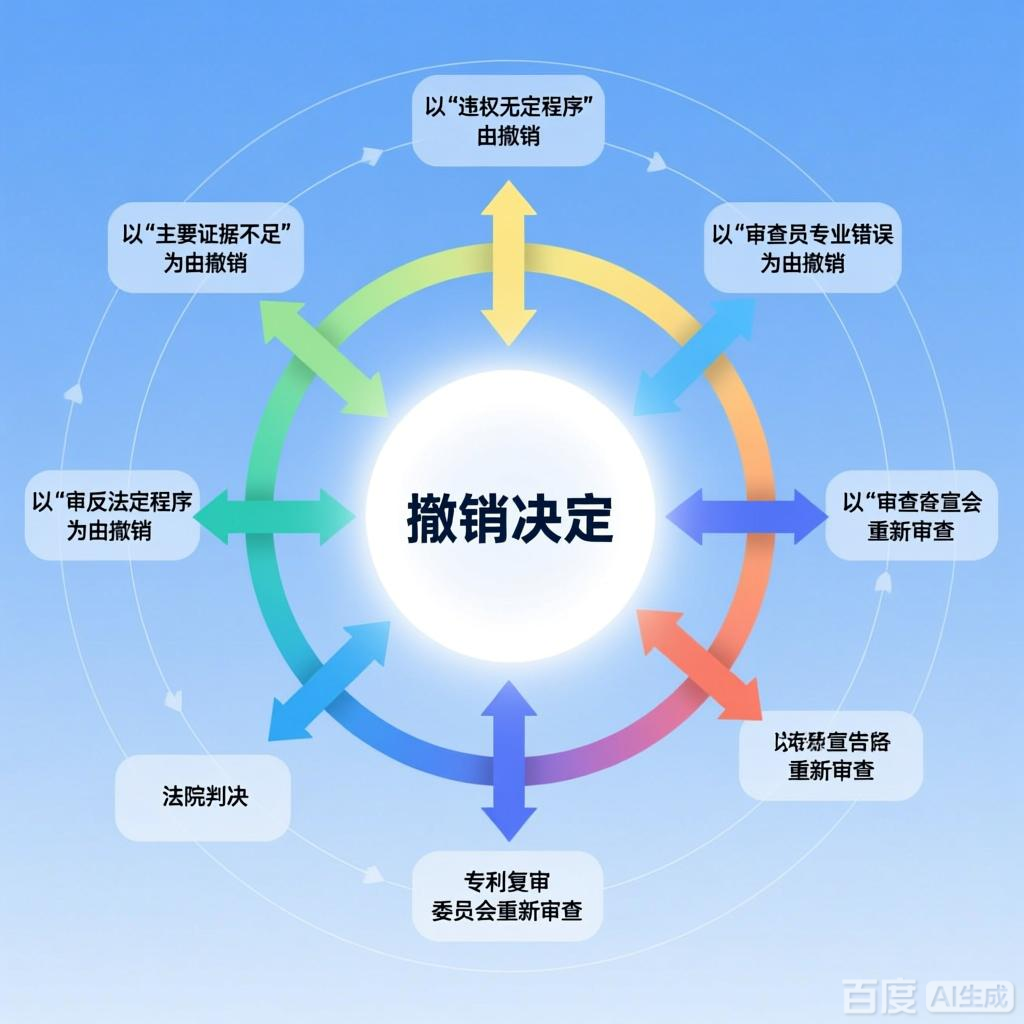
In practice, courts revoke invalidation decisions primarily for the following reasons: illegal invalidation proceedings; errors in evidence identification during invalidation proceedings; errors in determining the novelty or inventiveness of the claims; excessive amendments to the claims of the patent in question; unclear claims of the patent in question; insufficient disclosure in the specification of the patent in question; and lack of necessary technical features in the claims of the patent in question.
Among these, the most common reason is an error in determining the novelty or inventiveness of the claims, accounting for a significantly larger proportion of cases than those based on other reasons. Whether in invalidation proceedings or subsequent administrative litigation, novelty/inventiveness evaluation remains the most frequent issue. For example, in the case of “Multi-speed Motor Gear Recognition Method and Device,” the State Intellectual Property Office held that, based on the descriptions in claims 1 and 3, the real-time voltage value U can only be understood as the voltage value relative to the neutral wire. Even if claims 1 and 3 are accepted as using the live wire voltage as a reference voltage, such a setting is a common technical means in the field. Meanwhile, the other points of contention are common general knowledge. In the first instance, the Beijing Intellectual Property Court strictly evaluated the inventiveness of the relevant claims according to the “three-step method”. It held that, based on the textual descriptions in claims 1 and 3 of this patent, and in conjunction with the corroboration of the specific disclosures in the specification, a person skilled in the art could confirm that the real-time voltage value U in claims 1 and 3 of this patent is a measurement value relative to the mains live wire, which is different from the voltage value relative to the neutral wire measured in Evidence 1. As for other technical features, the evidence is completely different from the method principle of this patent, and the disputed distinguishing technical features have achieved unexpected technical effects, which are not common knowledge in the field. In the end, the Beijing Intellectual Property Court held that all claims of the patent in this case possessed inventiveness, and therefore ruled to revoke the appealed decision [2]. This case is a typical case issued by the Supreme People’s Court.
Although there are relatively many disputes in the evaluation of novelty/inventiveness, it is an aspect that must be paid attention to in the case. However, there are no two leaves that are exactly the same in the world, nor are there two cases that are exactly the same. Each case has its own characteristics, and some uncommon reasons should not be ignored. For example, in the case of “stainless steel brazed products,” the State Intellectual Property Office (SIPO) found two problems with the patent: 1. The amended claims expanded the scope of protection of the original patent, commonly known as “exceeding the scope of protection”; 2. The claims were not based on the specification, commonly known as “not supported.” Based on this, the SIPO declared the patent entirely invalid. The patentee, dissatisfied with the invalidation decision, filed a lawsuit in the Beijing Intellectual Property Court. The Beijing Intellectual Property Court held that the appealed decision was correct and dismissed the plaintiff’s (patentee’s) claims. The patentee still maintained that both the invalidation decision and the first-instance judgment were erroneous and appealed to the Supreme People’s Court. The Supreme People’s Court held that: 1. Regarding the method of amending claims, provided that the amendments to the claims meet the two legal standards of not exceeding the scope of the original specification and claims and not expanding the scope of protection of the original patent, a moderate relaxation of the amendment method helps the patent confirmation procedure focus on the core of the invention and creation, without affecting the public’s reliance on authorized patent documents. In this case, Alfa Laval’s modification method further limited the technical features of dependent claims 2 and 20 to authorized claim 1, which constitutes a further limitation of the claims, and this modification method should be accepted. 2. This case requires a reassessment of whether the patent complies with Article 26, Paragraph 4 of the Patent Law based on the modified claims. To avoid loss of the parties’ appeal interests, the State Intellectual Property Office should make a new determination based on the patentee’s modified claims. The Supreme People’s Court ultimately revoked the invalidation decision and the first-instance judgment [3]. It is worth noting that in this case, considering the appeal interests, after recognizing the error of the invalidation decision regarding “modification beyond the scope,” the Supreme People’s Court did not evaluate the issue of “not supporting,” but instead ordered the State Intellectual Property Office to re-examine the issue based on the modified claims. PART 04
Evidence Submitted in Patent Invalidation Administrative Disputes
Article 29 of the Provisions of the Supreme People’s Court on Several Issues Concerning the Application of Law in the Trial of Patent Grant and Confirmation Administrative Cases (I) stipulates that if a patent applicant or patentee provides new evidence in a patent grant and confirmation administrative case to prove that the patent application should not be rejected or that the patent right should be maintained, the people’s court should generally review it. Article 30 stipulates that if an invalidation requester provides new evidence in a patent confirmation administrative case, the people’s court generally will not review it, except for the following: (i) evidence proving common knowledge or customary design already asserted in the patent invalidation request examination procedure; (ii) evidence proving the knowledge level and cognitive ability of a person skilled in the art or a general consumer; (iii) evidence proving the design space of a design patent product or the overall state of existing designs; (iv) evidence supplementing the probative value of evidence already accepted in the patent invalidation request examination procedure; (v) evidence refuting evidence provided by other parties in the litigation.
Article 29 of the above provisions addresses the evidence submitted by patent applicants in patent application right disputes and patentees in patent ownership disputes, and the people’s court should review the evidence submitted by both. For both of these cases, administrative litigation is the last resort and the final opportunity to examine new evidence. Therefore, new evidence must be examined; otherwise, wrongful convictions are highly likely. Article 30 does not present this problem; the invalidation petitioner can file a new invalidation request based on new evidence. As long as the evidence is strong, there is no worry about the patent not being invalidated. In this case, administrative litigation is not necessarily the best option. However, the Supreme People’s Court still grants applicants the right to submit evidence of common knowledge, corroborating evidence, supplementary evidence, and supporting evidence in administrative litigation.
For example, in the case of “Automatic Dispensing and Metering Device for Pharmaceuticals,” the patentee, Sichuan Xinmou Pharmaceutical Co., Ltd., submitted supplementary evidence 1-7 in the first instance proceedings. Supplementary evidence 1-4 consisted of common knowledge evidence used to explain the concepts of “measuring cup orifice” and “measuring.” Supplementary evidence 5-7 was formed after the challenged decision was made, demonstrating the social contribution and commercial value of the patented technology. The court of first instance held that the seven supplementary pieces of evidence were not the basis for the State Intellectual Property Office’s decision and should not be used as factual basis for the court to review whether the decision was legal. The Supreme People’s Court held that evidence that does not involve new facts and reasons, evidence related to the knowledge level and cognitive ability of technicians or general consumers in the relevant technical field, and rebuttal evidence may be submitted and reviewed. The People’s Court should conduct a substantive review of the authenticity, legality, and relevance of the above evidence before making a determination on whether it should be accepted. Based on the new evidence, the court supported the appellant’s corresponding claims and revoked the first-instance judgment and the invalidation decision[4].
PART 05
Summary and Outlook
The determination of errors in administrative acts and their remedies are important issues to be addressed in administrative law research. As an administrative act, the decision to invalidate a patent is inevitably subject to the possibility of errors. The correction of errors in patent invalidation requests mainly depends on the first-instance procedure of the Beijing Intellectual Property Court and the second-instance procedure of the Intellectual Property Court of the Supreme People’s Court. As long as the factual basis is sufficient and appropriate strategies are adopted, the law will correctly confirm the validity of each patent right. References:
[1] Supreme People’s Court, Administrative Judgment No. 132 of 2022.
[2] Beijing Intellectual Property Court, Administrative Judgment No. 1456 of 2015.
[3] Supreme People’s Court, Administrative Judgment No. 19 of 2019.
[4] Supreme People’s Court, Administrative Judgment No. 93 of 2021.